My guest for today's author interview is historical novelist, Dr Andrew Latham. He is new on the historical fiction scene, with his debut novel,
The Holy Lance, hitting the shops about the same time as my own debut. He is not, however, a newbie when it comes to writing, being a many-times published academic. He is a professor in the Political Science Department of Macalester College, Minnesota, USA. So, what made him decide to turn his pen to fiction? Well, sit back, relax and in the following interview perhaps you'll find out.
(Note: The Holy Lance is currently on sale in the UK and US until 10th July - pick it up here in e-book format for only 0.99!)
First thing's first. Tell us a bit about your debut novel, The Holy Lance.
Well, I guess I’d call it a historical military adventure. You know the type (having recently published one yourself) – heroic protagonists, evil villains, a noble goal, lots of battles and bloodshed, all set in the distant past. I grew up reading the classics in this genre: series like C.S. Forester’s Hornblower, Alexander Kent’s Bolitho, and Patrick O’Brian’s Aubrey-Maturin. And in more recent years I have enjoyed the novels of Ben Kane, Conn Iggulden, Si Turney, Robyn Young, Helena Schraeder and, of course, Bernard Cornwell. I like to think that in some way The Holy Lance is part of this literary tradition.
The story line is pretty simple. It’s 1191 and the Third Crusade is underway. A daring counterattack against the Saracens’ last-ditch effort to relieve the besieged city of Acre has not only saved the Christian host from a fatal defeat; it has also brought the leader of that counterattack, English Templar Michael Fitz Alan, to the attention of King Richard the Lionheart. In the days that follow, the king charges Fitz Alan with a life-or-death mission – to recover the Holy Lance, a long-lost religious relic widely believed to be responsible for the near-miraculous success of the First Crusade. The ensuing quest leads Fitz Alan and a hand-picked band of Templars on a journey deep into enemy territory, where they battle Saracens, Assassins, hostile Christians and even a traitor within their own ranks as they seek to return the Holy Lance to Christian hands and thereby ensure the success of the crusade.

What made you decide to write a novel – you have lots of non-fiction articles and books published, so why decide to branch into fiction now?
Well to be honest, until about three years ago I never dreamed I’d write a work of historical fiction. I’d always loved reading historical military adventures, but it simply never occurred to me that I might write one someday. Scholarly books, yes – that’s what scholars do. But a novel? I have to confess that the thought never even crossed my mind.
All that changed, though, as I was nearing completion of my most recent non-fiction book Theorizing Medieval Geopolitics. In preparation for writing that book, I’d been reading pretty widely about war and political violence in later medieval Europe and had just begun to get handle on the crusades. Then one day I encountered the Templar knights. Like most people, I thought I knew what these guys were all about: either odious religious fanatics or cynical secular thugs using religion to camouflage their all-too-worldly motives. Like most people, though, I was wrong. Turns out, there was much more to these warrior-monks than I had initially thought or than is commonly supposed. The more I read, the more I became fascinated by these “new knights”, the Templars in particular – not by the caricature of them that is so prevalent in contemporary popular culture, but by the historical reality of them.
Being a scholar by both training and inclination, my first thought was to make sense of this weird phenomenon by writing a non-fiction book on the topic. The more I thought about what I wanted to achieve, however, the more it seemed that non-fiction would not be the best tool. I was interested in the Templars, not because of their supposed secrets or mysteries, or their fabulous wealth and influence, or even their marital exploits, but because of what they were: warrior-monks. Think about it for a moment. On the one hand, Templars, like all medieval knights, were warriors, bred to be brutal and merciless killers. On the other, they were pious monks, committed to a life of prayer and works of charity. How was that possible? How did they reconcile these two personas? And how did they do so in a way that made them the most effective military force in the Latin East? Answering these questions – that is, trying to make sense of the actual reality of Templar life – was what really what inspired me to write the novel.
And what better way to get at these questions than to approach them via one of the oldest stories in human culture – the quest. Basically, The Holy Lance tries to illuminate the reality of the Templar life by chronicling the transformation – through a series of challenges encountered while trying to recover a potent religious relic – of one vicious-if-repentant “worldly knight” into a vicious-but-reformed “New Knight” (the former being a brutal killer serving his own selfish ends; the latter being a brutal killer serving a higher good and in the process seeking his own redemption). The protagonist, Michael Fitz Alan, is charged with recovering the long lost Holy Lance, a religious relic widely believed to be responsible for the near-miraculous success of the First Crusade. Along the way, Fitz Alan faces a number of trials. In dealing with these trials, he sometimes errs on the side of the brutal warrior; other times, on the side of the pious monk. Learning from these trials, by the end of the novel he has worked out how to be both – that is, to reconcile these two warring elements of his personality in a way that harnesses his superior martial skills to a higher, more noble cause.
I should note at this point that none of this is to imply that Fitz Alan’s a saint – like all great military adventure heroes, he most assuredly isn’t. It is, however, to place him in his proper historical context. Fitz Alan isn’t simply a twenty-first century (presumably secular-humanist hero) parachuted into a story set in the twelfth century. Rather, he’s my very best educated guess about what a twelfth century hero would actually look like. As such, like almost all people in medieval Christendom, Fitz Alan understands the world in terms of Christian religious categories and concepts. For the people of Medieval Latin Christendom, these beliefs were neither a symptom of mental illness nor a cynical ideological smokescreen concealing their true motives (power, wealth, glory, pleasure, what have you). Instead, rather like the laws of physics are for us, Christian religious categories and concepts provided the fundamental imaginative matrix through which medieval people made sense of – and thus acted in – the world around them. As I see it, not taking the medieval religious worldview seriously would simply be to get Fitz Alan – and his world -- entirely wrong.
And why a quest for a religious relic?
A couple of reasons, I suppose. First, the Templars were obsessed with such relics. They truly believed them to be both significant in their own right and as a kind of “force multiplier” that would help them in their battles with the Saracens. Second, after the Holy Grail (which does in fact make a brief appearance in the novel) the Lance was probably the most important relic in all of Christendom. In my judgement, however, every possible permutation of the Grail story has now been done (Monty Python, Dan Brown, Bernard Cornwell, Umberto Eco… the list goes on). So, if the Holy Grail’s already been done to death, why not use the next best thing – the Holy Lance? Perhaps if I were Dan Brown (or a literary theorist) I might say that I also like the way the Lance – the weapon that pierced the side of Christ as he hung of the Cross – symbolically embodies the intermingling of the martial and the religious.
What drew you to the Third Crusade, rather than another historical event or period?
Again, a couple of reasons. To begin with, the Third Crusade resonates in the popular culture more than any other (with the possible exception of the First). Some combination of the Richard-Saladin relationship and the so-near-yet-so-far nature of the campaign has made this particular remarkably appealing down through the ages. Perhaps more importantly, though, I really wanted a setting that would allow me to draw a sharp contrast between the worldly knight and Saint Bernard’s New Knight. Having the story set in the Third Crusade allows me to contrast King Richard (the ultimate “worldly knight”) with Michael Fitz Alan (the ultimate “New Knight”) in what I think are revealing and interesting ways.
That being said, however, this novel is not simply an academic work dressed up as fiction. As I said earlier, I grew up reading the classics in historical military adventure. These novels taught me what good historical fiction looks like. My goal in writing The Holy Lance was to apply everything I learned from these great writers to provide an insightful yet entertaining account of the Templars and the Third Crusade.
What or who was your inspiration for this character?
I suppose Fitz Alan is partly inspired by all those great warrior heroes of both classical mythology and contemporary historical fiction – heroes like C.S. Forester’s Horatio Hornblower, Bernard Cornwell’s Richard Sharpe and Thomas of Hookton, Si Turney’s Marcus Falerius Fronto, and Simon Scarrow’s Cato and Macro. He’s been groomed from birth to be a warrior and leader of warriors; he has great skill-at-arms and is an accomplished and extraordinarily proficient killer; he is courageous, resourceful and tough. When pushed, he is capable of extraordinary savagery and ruthlessness. He lives to fight and is constitutionally incapable of turning his back on the warrior life. Fitz Alan is also, however, wracked by a profound sense of sinfulness. Caught up in the intense lay piety of his era, he increasingly sees the warrior life he has been leading as morally corrupt, spiritually empty and sure to earn him eternal damnation. Seeking to reconcile these two deeply contradictory elements of his personality, he considers “taking the cross” (i.e. going on crusade), but ultimately joins the order of the knights Templar instead. His reasoning is that as a Templar he will be able to continue fighting, but will do so for both a higher purpose and his own personal salvation.
Initially, while in England, Fitz Alan focuses on the spiritual disciplines, learning the new life of the Christian monk. After leaving England, however, the realities of war progressively transform him into a perfect synthesis of the warrior and monk: a brutal and capable fighter motivated by a proper inward disposition, faithfully fighting on behalf of what he considers to be the only truly just cause in this life (defending Christ and His Church). In other words, he is transformed from a brutal secular knight, into a quintessential exemplar of St. Bernard's “new knighthood” – a perfect knight and perfect monk, fighting a “double combat of flesh and spirit”. He believes his redemption in both this life and the next depends on both killing the enemies of the Church and living an ascetic and pious religious life that sustains his proper spiritual disposition (humility before God and obedience to His Church).
Fundamentally, then, Fitz Alan is an archetypal warrior hero: courageous, clever, resourceful, idealistic, tough and, of course, a peerless fighter. Like all such heroes, however, Fitz Alan is also “wounded”. Externally, this takes the form of a recurring pain in his shoulder (a rotator cuff injury, which I have to assume was common among people who spent so much time swinging a heavy sword). Internally, it takes the form of a longing for spiritual redemption that can only be fulfilled by living the Templar ideal as fully as possible. It is the effort to realize this ideal – to strike the perfect balance between the warrior and the monk – that both animates Fitz Alan and makes him interesting.
But although he shares a great deal of DNA with other great heroes of the genre, he differs in one important respect – he’s also very much inspired by Bernard of Clairveaux’s ideal of the “new knight”. Whereas most heroes in military historical fiction are either irreligious or adherents to some form of pre-Christian religion, the Fitz Alan character was fundamentally inspired by my desire to figure out what made Saint Bernard’s so-called knights of Christ really “tick”. In a sense, then, what I have done with Fitz Alan is to take Saint Bernard’s highly stylized vision of what a Christian a holy warrior should look like and bring that vision to life by exploring the interior life – the motivations, struggles and inner conflicts – of those who belonged to a military religious order like the Templars.
Did you consider writing in any other historical period? Would you consider it? If so, what period/place other than the crusades interests you most?
As this novel emerged rather organically out of my academic work on medieval war I never really considered any other historical period. For reasons already discussed, I did narrow the focus down to the Third Crusade. On reflection, though, I never really seriously thought about any other medieval crusade.
And for the time being I’m going to stick with the Third Crusade. This past January I was able to sketch out a pretty detailed outline for the next installment of what is currently conceived as a trilogy but which may evolve into a longer series. And, now that it’s officially summer break, I’ve begun drafting. The goal is to complete the sequel to The Holy Lance before September and write the final installment in January/summer of 2016. Whatever happens, I promise Michael Fitz Alan will definitely see the Third Crusade through to its bitter end.
After that, and providing people actually read what I write, I’ll continue writing historical fiction (can’t see myself venturing beyond that genre, but one never knows). I may keep on with the English Templars – I already have many, many more stories half-developed for this “band of brothers” ready to go – but I may also branch out a bit. The Hundred Years War appeals a very great deal, as does the First World War (I’ve written or taught about both in recent years). I guess we’ll just have to wait and see.
I saw you recently asking your Facebook friends whether you should start writing your second novel, or work on academia. It seemed the results were overwhelmingly in favour of the sequel to The Holy Lance. Was this a surprise to you, and did you secretly hope they would back what you really wanted to do anyway, or were you really open-minded about what to work on?
I was genuinely torn (and, therefore, genuinely open-minded). I love being a scholar and writing scholarly works and I had mapped out and researched a non-fiction book project dealing with the evolution of the idea of “sovereignty” in later medieval political thought. I was chomping at the bit and had even ginned up some preliminary interest from a very, very good university press. But I’ve also discovered that I love writing fiction, too. I’d spent most of the Christmas break working up an outline for the sequel to The Holy Lance and really wanted to get moving on that project as well.
Now, believe it or not, I don’t actually think I have it in me to work on both of these projects at the same time. It really did have to be one or the other. So, I put the question to friends in both my “real” world and in the social media world. And here’s where the results surprised me a bit. I had fully expected that my novelist friends would say “write the novel”. And that they did. But I also expected my academic friends to say “write the scholarly book” – and they didn’t. Almost all of them (and some I know had read The Holy Lance) also encouraged me to write the next novel. That really surprised me! It’s entirely possible, of course, that this is down to nothing more than they think my scholarship is rubbish and that rather than waste any more time and effort on that I should get on with writing fiction. Or maybe it’s the weird mystique around novels and novel writing. I can’t really say. In any case, I decided to write the novel this summer and try to grind out the academic book next year.
Were there any surprises for you while writing The Holy Lance?
The biggest surprise was discovering how much I loved writing fiction. Not every minute of every day, of course. The writing process (or rather, my writing process) is just not like that. But overall, it was a truly joyful experience – the research, the character development, the plotting, the drafting, right through to the revising and editing (well, maybe not the final line-editing – nobody likes that). Very different from academic writing, which can be very fulfilling and professionally satisfying, but seldom induces feelings of joy (for either writer or reader).
Were there any challenges?
I suppose the most obvious challenge was finding the time to actually write. Like many writers, I have a full-time day job and young kids and between the two of them every hour of every day seems to get chewed up. On the other hand, the nature of my job as a university professor means that I have big chunks of time in January and over the summer when I can write full time, so maybe I shouldn’t complain too much.
Beyond that, the really big challenge for me was to shift gears from writing like a scholar to writing like a novelist. I’ve been writing like an academic my whole adult life and it is really hard to resist the temptation to support every claim with a footnote or to explain every move in excruciating detail. But perhaps even more challenging than switching off my inner scholar was switching on my inner novelist. Before this novel, the last piece of fiction I can recall writing was a short story I did in elementary school. So, in addition to all the historical research I did in preparation for the novel, I also had to research the craft of writing fiction. Thankfully, most (though not all) of that research involved re-reading great works of historical fiction with an eye to reverse engineering them – that is, with an eye to seeing how the master’s worked their literary magic – so it wasn’t as painful or difficult as it might have been.
As an academic, how crucial do you think historical accuracy is in historical fiction? Would you ever consider twisting facts to suit the story you would like to tell? Or perhaps you’ve already done that in The Holy Lance?
I think this is incredibly important, because if we don’t get the history correct then we’re writing fantasy or something else other than historical fiction. And by “getting the history correct”, I mean three things. First, the facts need to be accurate. Everything from dates, to idiom, to forms of dress, to food need to be accurately portrayed. If they are not – if, for example, I were to have my Templar protagonist say something like “that was over the top” or to have a burger and fries for dinner – then the credibility of the work would be compromised and readers would have a hard time entering fully into the historical world in which the novel is set. Now, there are gaps in the historical record, things we simply don’t know. And there is always scope for interpretation: was Thomas Cromwell the hero, or was it really Thomas More, to take but one example that is in the ether these days? But in good historical fiction the facts as we know them need to be accurately portrayed and respected.
Second, getting the history correct means correctly identifying and working into the story those constants of the human condition. Human beings have been hardwired the same way for millennia and that means that there are certain universals that hold true regardless of time and place. The pursuit of power, glory, wealth and (sexual) pleasure are constants that have driven human history since the beginning of time. But so are the pursuit of Truth, Beauty and Goodness. I think good historical fiction needs to reflect these constants.
Third, getting the history correct means recreating the “imaginative structures” of a particular time and place. While there are constants in the human condition, the way in which people understand, interpret and make those constants meaningful can and do change dramatically across time and space. Love is felt and expressed differently in 12th century Europe than in 18th century China, for example. In The Holy Lance, this meant that I had to accept that, for medieval Europeans, divine law was the basic interpretive matrix though which they understood and acted in the world. It wasn’t a ploy or a smokescreen. It wasn’t a mental illness. It wasn’t a cynically adopted mask. It was deeply and authentically the way they understood and invested meaning in the world. As I said earlier, for them divine law played the role that for us would be played by the laws of physics. In my view, getting this right was essential to telling my story. Failure to accurately recreate this basic imaginative structure would have resulted in me committing the sin of anachronism – but in a way much worse than just getting a piece of clothing or a turn of phrase wrong.
Now, that third one probably sounds like an unrealistic standard, so let me qualify it just a bit. It’s impossible, of course, for an author to completely leave behind their own thought-world and simply recreate a historical one. Obviously, the imaginative structure of our own time and place cannot be plucked from our brains, put on a shelf and be replaced with one labelled “12th century Latin Christendom.” An author of historical fiction, even a very good one, will always be striving to meet a standard that cannot be fully realized. And, of course, one is constrained by language, which always shapes thought. It was impossible for me, for example, to fully recreate the thought-world of a 12th Templar knight in modern English – something was inevitably going to be “lost in translation”. And finally we are also constrained by the need to impose a recognizable dramatic structure on events (in my case, the “quest” narrative). So there are limits to recreating an historical thought world. On the other hand, there is nothing that turns me off faster than a 21st century hero projected back into a distant historical setting. (Well, there is one thing: rewriting history to make it serve a modern political project. See debates swirling around Hilary Mantel these days.)
What writer or book has had the biggest influence on your work?
I bet you think I’m going to say Bernard Cornwell, don’t you?
(Matthew: Well, I did wonder!) Well, I’m going to shock you – it is not Bernard Cornwell. When I think back on it, the biggest influence on my work was C.S. Forester’s twelve-book Hornblower series. I read (and re-read) these as a teenager and they have stuck with me ever since. His mastery of technical detail, his vivid recreation of the imaginative structure of the times, his wonderful characters – all these have had a huge impact on the way I think military historical fiction ought to be done. So, I like to think there is much of Forester style and approach to be found in The Holy Lance. There are huge differences, of course: period, theme, plot, etc. And, while Hornblower was always off on a mission that kept him out of the major battles of his time, that is certainly not true of my protagonist Michael Fitz Alan. In the next instalment of the series, for example, he’ll be fighting in the Battle of Arsuf, one of the major battles of the crusades. On the whole, though, if my approach to historical fiction writing is influenced by anyone, it’s Forester.

Now, as everyone knows, Cornwell was also inspired by Forester. And I do love his Sharpe and Grail Quest series. And, in some ways, I’ve consciously made Fitz Alan the polar opposite of characters like Richard Sharpe and Thomas of Hookton (similarly heroic, but with radically different motives and sensibilities). So, in answering your question, Cornwell does get an honourable mention. But then, how could he not?
What is the best book you've read in the last twelve months?
I’ve read many, many good books over the last year and many of them have been fiction (new works by Ben Kane, Si Turney, Conn Iggulden, Helena Schraeder, Char Newcomb, some guy named Matthew Harffy – the list goes on).
(Matthew: Aha! The obligatory mention of my book! You can come again, Andrew!) But the best work I’ve read (actually, reread, as I’d first read it many years back) was John Gillingham’s political biography of Richard I. It meets my academic standards for quality research, but unlike many academic works it is very readable – indeed, it’s an absolute delight to read. If you haven’t read it, and are at all interested in the Third Crusade or the late 12th-century Angevin Empire, this is an absolute “must-read”!
Do you have a special place or a particular time of day for writing?
The rhythms of my fiction-writing life are governed to a large degree by the rhythms of my scholarly life (not to mention those of my life as a father). Given my responsibilities as a teacher, scholar and citizen of the college (a euphemism for member of multiple college committees) I’m generally free to write fiction only during January and then again over the summer break. This makes for a fairly compressed writing “season”, but I can’t really complain. During the months when I’m free to write I really am free to write – full time and without much in the way of distraction or diversion. As to the particular times of day that I like to write, it works out that I typically write in shifts. The first is in the morning when I spend three or four hours drafting bits and pieces of the book. I’m not terribly linear about this so the passage that I happen to be working on any given morning might be the next bit of the chapter I’m currently drafting or it could be a passage that I think I might need several chapters down the line. The second shift starts a couple of hours before retiring for the evening (i.e. after the kids have gone to bed). During this time I generally work on revisions or perhaps a little research to get me started in the morning. I never really sat down and planned my writing schedule this way – the routine just sort of evolved organically over many years of writing scholarly non-fiction works and I carried it over into my fiction-writing career.
As to where I write, well, that all depends. I typically write at home – and when I do, I do so in my (not very special, but quite utilitarian) office during the morning and at the kitchen table in the evenings. When it has been necessary, however, I have also written while visiting my parents in Toronto and while staying with my in-laws in Winnipeg. Away from home, I write wherever I can open my notebook with a modicum of peace and quiet (or a minimum of distractions, whichever bar is lower).
I can safely, honestly and without qualification say that I have never written so much as a word of fiction in a coffee shop or pub, on a beach, at a writers’ retreat, on an airplane or train, in my backyard or (perish the thought) at my office at the college.
Did you consider independently publishing your novel, or had you decided on the traditional publishing route from the beginning? How hard was it for you to get a publishing deal? Did any part of the process surprise you?
As I was nearing completion of the novel I began researching the publishing industry. I’m imagining this is a pretty common experience, with aspiring novelists trying to figure out how that industry is organized and how to “break though” and get published. After a few months of this, I decided that I would spend one year seeking a traditional publishing contract and if that didn’t pan out I’d try the self-publishing route. Can’t remember now why I decided that, but I do remember consciously adopting that as a strategy. I then started identifying those publishers who were interested in publishing historical fiction and who would accept direct submissions (I had never bothered seeking an agent, though I can’t now remember why not). I identified two that fit the bill and sent solicitations off to both. Both publishers were very interested right off the bat, but KRP made me an offer first and I jumped at it. The whole process took a few months.
In a sense, then, I suppose it wasn’t hard to secure the actual contract. Two solicitations wasn’t that much work. And a few months was not that much time to invest. I do, however, consider myself incredibly fortunate. I know that for many authors, the process is far more torturous. And I have few illusions about that things worked out for me so quickly because of the deathless quality of my prose. I got lucky, very luck, and I know it – and I’m thankful everyday that things worked out as they did.
And now for the quick-fire questions:
Tea or coffee?
I grew up a tea drinker, but since my university days it’s been coffee.
Burger or hot dog?
Burger or brat, but never a hot dog.
Villain or hero?
Takes both to make a story work, but I identify with heroes
Beer or wine?
Beer as a younger man, but only wine these days.
Movie or TV series?
If I had unlimited resources and complete artistic control I could see making The English Templars series (The Holy Lance is book #1) as a TV series like “Band of Brothers” or “Pacific”.
Happy ending or tragedy?
I like both, but if pushed would tend toward tragedy (one of those constants of the human condition I mentioned above)
In the car, audio-book or music?
News, I’m afraid. Except in the run up to Christmas when the kids insist on the Holiday Music station.
Thanks so much, Andrew, for taking the time to answer my questions in such depth. All the best with
The Holy Lance and its sequel (once you've written it!).
Find out more about Andrew's writing and books here:
Website:
www.aalatham.com
Facebook:
https://www.facebook.com/andrew.latham.1048
Twitter:
@aalatham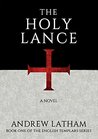 The Holy Lance by Andrew Latham


