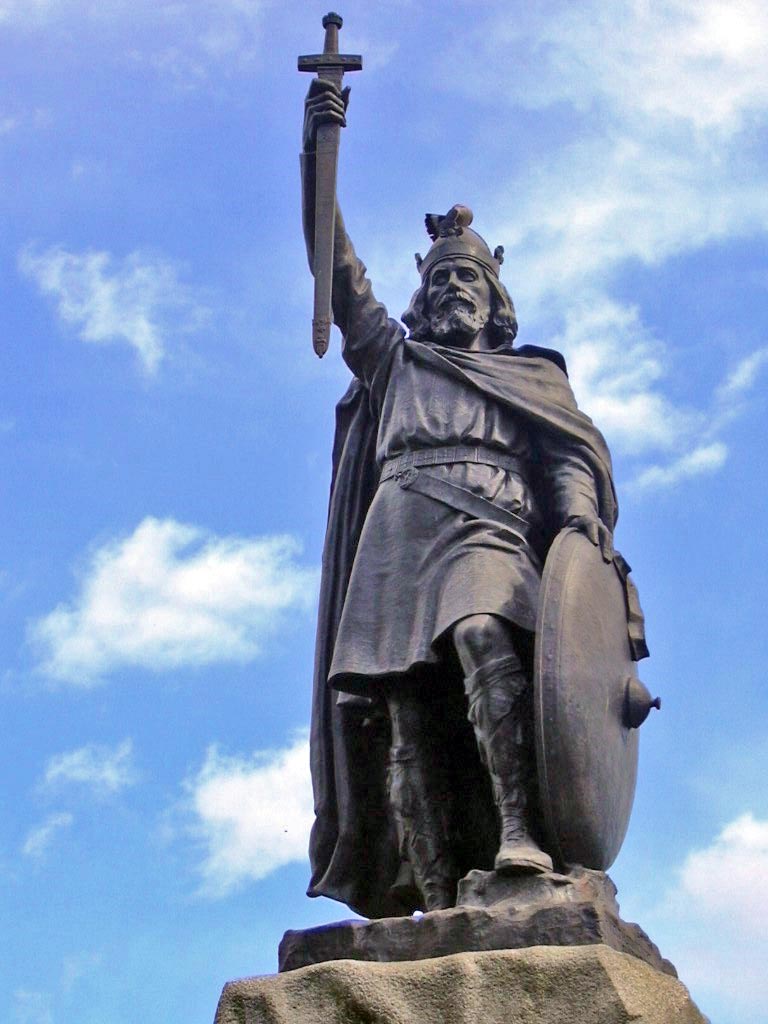
Showing posts with label dark ages. Show all posts

Tuesday, 14 February 2023

REVIEW: Usurper (The Wulfbury Chronicles Book 1) by P. W. Finch

Usurper: an epic medieval adventure (The Wulfbury Chronicles Book 1)Usurper: an epic medieval adventure by P. W. Finch
My rating: 4 of 5 stars

Usurper is an action-packed, coming-of-age, adventure set against the upheaval and battles of 1066. Finch gives us Cerdic, a troubled hero thrown into the maelstrom of events outside of his control, and we follow him breathlessly as he deals with brutal Vikings, familial rivalries, unrequited love, invading Normans and more!

View all my reviews

Monday, 11 April 2022

Typical early medieval terrain

A walk with Blue uncovers an area of marshland near a river that would be just the sort of terrain all over Britain in the early medieval period (aka Dark Ages).


Friday, 21 December 2018

Dark Ages Heroes - Who's yours?

To coincide with the hardback release of KILLER OF KINGS, I recently wrote an article on the English Historical Fiction Authors blog about heroes of the so-called Dark Ages.


Who do you think I wrote about and who would your hero (or heroine) be?

If I were to ask a group of people to name a hero from the Early Medieval period, the era more commonly known as the Dark Ages, who do you think they might mention? Alfred the Great perhaps? After all, he is the only king to be known as “Great” that Britain has ever produced.


Read the full article here: https://englishhistoryauthors.blogspot.com/2018/12/heroes-of-dark-ages-whos-yours.html


Christmas in the seventh century

Ever wondered how people would celebrated Christmas in the time of the Bernicia Chronicles?

Well, wonder no longer. Fellow historical fiction author Mary Anne Yarde asked me to write something about Christmas on her blog.

Here is the result:

"Come, remove your sodden cloak and take a place on the bench. The fire is warm and there is food and drink a-plenty." The bearded man looks at you askance. "Even one who has travelled so far to be here tonight."

He ushers you towards the long bench where others are seated around the central hearth. The feast is already well underway and the men raise their cups and drinking horns to you as they slide along, making way for you to sit. 

"I see from your apparel that you have come a long way to be here in our Lord King Edwin's hall at Gefrin," says the steward as you settle onto the wooden bench. "I note you have no eating knife. I will fetch you one." And with that he is gone, bustling away through the servants and thralls who attend the revellers.

Read on here:
https://maryanneyarde.blogspot.com/2018/12/christmas-in-early-seventh-century.html

Friday, 15 December 2017

What Mark Noce Learnt When Writing About Medieval Wales


Today I am pleased to welcome to my blog, Mark Noce, author of the Queen Branwen Series. Mark was born and raised in the San Francisco Bay Area, and is an avid traveler and backpacker. By day, he works as a Technical Writer, having spent much of his career at places like Google and Facebook. When not reading or writing, he's probably listening to U2, sailing his dad's boat, or gardening with his family.


What Mark Noce Learnt When Writing About Medieval Wales

Thanks for having me here today and giving me an opportunity to talk about my latest novel, Dark Winds Rising! Set in early medieval Wales, Dark Winds Rising is the sequel to Between Two Fires and the latest in the Queen Branwen Series that chronicles the life of a young Welsh queen who must confront Saxon and Pict invaders in order to save her people and her family.


As a historical fiction author, I’ve been fascinated by all eras of history and enthralling real life stories from the myths and legends accompanying them. Along with my degrees in Literature and History, I’ve always found that research goes beyond merely reading the available “facts” of an era. Two invaluable aspects that inform my writing are what I consider a hands on approach and a hypothetical approach. Hands on basically means that if I write about my character growing wheat, then I research what type of wheat was grown and actually grow it in my own yard, harvest it and mill it by hand (yes, I’ve actually done this). Little things like this really give me details I couldn’t find anywhere else and also brings up emotions that are quite useful – such as what it feels like if a wild animal eats the wheat you’ve spent three months raising!

The hypothetical approach involves using myths and legends for information. What is a myth? Even though it may be “untrue,” it’s basically a hypothetical situation that lets you know what a historical people thought was correct and what was not. It tells you what they valued, what they would do, and wouldn’t do. Medieval Wales is certainly rich in legend and myth, from Arthurian to the Mabinogion.


These types of approaches were invaluable to me when researching early medieval Wales, because very little has actually survived from the period. The longest piece of surviving text comes from St. Gildas, and it’s less than 30 pages. That gives you an idea of the stress society underwent at the time. The archaeology bears out large scale destruction and few preserved remains. However, common sense also tells us that the Welsh people clearly endured, survived, and continued to persevere because they are alive and well today. These were some of the salient facts that informed me when putting together the historical backstory for Queen Branwen’s plight. Even though Branwen herself is an amalgamation of historical characters, she is very real in her situation and is both a creation of history and the heart.


Buy Between Two Fires
Buy Dark Winds Rising

Connect with Mark Noce

Marknoce.com

Wednesday, 30 August 2017

Inspiration from The Dark Ages: Why I Wrote The Serpent Sword

If you’d asked me to name some Anglo-Saxon kings before I started writing The Serpent Sword, I would probably have managed Alfred the Great, perhaps Ethelred the Unready and that last great Anglo-Saxon king, Harold, of the Battle of Hastings, 1066 and arrow-in-the-eye fame. I think most people would probably be in the same boat as I was. There are other periods that I knew a lot more about. School history lessons focussed more on the Tudors, the Norman Conquest, the medieval period of the Crusades and the Hundred Years War, and then of course, the Industrial Revolution, and the two World Wars of the twentieth century.

The Romans might have got a mention at school, and those ever-popular raping and pillaging Vikings. They were always a firm favourite with teachers and students alike. Especially young boys like me, who imagined themselves riding the waves on a dragon-prowed longship and relished the horrific tales of battle and the perhaps fictional blood-eagle. But the Vikings didn’t come to Britain until the end of the 8th century, long after the stories I write have finished.


So, if I knew next to nothing about the early seventh century, why did I choose to write my debut novel about a young man in Northumbria in 633 AD? After all, writing a novel is hard enough, without choosing a subject you haven’t got a clue about. The real answer is that I didn’t choose the period, it chose me. So what makes someone who has never written a novel decide to pick up a pen, or more likely nowadays, sit down at their computer?


Well, in my case, it was a television programme one evening back in 2001. It was about archaeological digs taking place in and around Bamburgh Castle in Northumberland. I had lived near there as a child and always loved the area, so I watched with interest. I was alone at home that evening and something sparked inside me. I fired up the PC and started to type descriptions of the images that were thronging in my mind. I wrote a scene of a young man arriving on the beach at Bebbanburg (the old name for Bamburgh). I had never written anything of novel length before and I had a full-time job, a young family and I was halfway through studying for a degree, so progress was never going to be fast.

But something about the story just kept nagging at me. Who was this man I saw in my mind’s eye? Why had he arrived by ship? Where had he come from?


I started buying any books I could find on the period, and the more I learnt about the so-called Dark Ages in Britain, the more I became hooked. I discovered that Britain was made up of small kingdoms. The Romans had left a couple of centuries before, but war was still frequent between the different Anglo-Saxon rulers. And there were also regions ruled by native Britons. Welsh, Scots and Picts all vied against the Germanic peoples who had settled the land after the Romans had left these shores. I learnt the names of Anglo-Saxon kings that should be taught in all schools: Edwin, Oswald, Oswiu, Penda and many more. They were not kings of England, but kings of exotic sounding places like Bernicia, Deira, and Mercia. But these were men who helped to forge the land we know as England (the name itself comes from Angleland).

My research in the area brought back memories of my childhood in a village on the border of England and Scotland. The wildness of that land had always stayed with me. The rocky coastline of the North Sea, birds wheeling in a leaden sky, the snow-capped Cheviot Hills on the horizon. It was easy to imagine men and women living, fighting and dying in that land 1,400 years earlier. Men and women just like you and me, with loves, passions, fears, and yet so far removed from us that they could easily be thought of as truly alien.


They lived in a time of turmoil and uncertainty. Kings with retinues of warriors defended their people against attack, but such protection was often short-lived, with most kings meeting their ends in bloody battles. Religion too was in flux, with the resurgence of Christianity spreading over the land. However, in the early part of the seventh century, it was still very much the new religion, in competition with old gods we more commonly relate with the Vikings.


The term ‘Dark Ages’ has become outmoded in recent years, with academics now preferring ‘Early Medieval’. But I believe that despite the enlightenment of some during that time and the incredible skill of craftsmen who produced intricate and exquisite jewellery, weapons and armour, the period really is dark. It is lost to us in the gloomy distance of the past. Something about the men and women of the seventh century inspired me one night fifteen years ago, and they have been speaking ever since.

All I can do is listen and tell their tales as best I can. 

Tuesday, 8 August 2017

What Mary Anne Yarde Learnt about the folklore of King Arthur when writing The Du Lac Chronicles

It is my pleasure to welcome to my blog Mary Anne Yarde, award-winning author of the International Bestselling series, The Du Lac Chronicles.


Mary Anne grew up in the southwest of England, surrounded and influenced by centuries of history and mythology. Glastonbury, the fabled Isle of Avalon, was a mere fifteen-minute drive from her home, and tales of King Arthur and his knights were part of her childhood.

What Mary Anne Yarde Learnt about the folklore of King Arthur when writing The Du Lac Chronicles


I have always been passionate about history. One Christmas, I must have been around three-years-old, my Grandmother bought us a set of encyclopaedia — I know that does not sound particularly exciting, but I loved those books. I would often take one of these massive books off the shelf. I would then lie on my stomach, on the floor, flick through the pages and look at the pictures. I don’t know how I knew which one was the history encyclopaedia, but that was the one I always got down. History fascinated me, and it still does.

Growing up near Glastonbury meant that I knew, from a very early age, all about the stories of King Arthur and his Knights. What I didn’t know was that this love for history and King Arthur was not only going to inspire me to write an award winning book series, The Du Lac Chronicles, but also I was going to become a lover of folklore.


Researching the life and times of King Arthur is incredibly challenging. I am not going to say I have discovered who Arthur was because I haven't. There are so many possible Arthurs, so many theses as to who he was. But one thing where Arthur is prevalent, and you are sure to find him, is in folklore.

Folklore isn’t an exact science. It evolves. It is constantly changing. It is added to. Digging up folklore, I found, is not the same as extracting relics!

Arthur, as I said, lends himself to folklore, but it isn’t just Arthur the man I found myself looking for. I wanted to discover what influence he has had on Britain over the centuries, and what I found, surprised me.


The Dark Ages, where the majority of Arthurian stories are set, is notoriously difficult to research because of the lack of primary written sources. Of course, there are the works of Gildas, Nennius and Bede as well as The Annals of Wales, that we can turn to, but again, they are not what I would consider reliable sources, even the Anglo-Saxon Chronicles, which were compiled in the late 9th Century, have to be treated with caution. Archaeologists have had more luck, but even they have not found Arthur, and they did try — they spent four years trying to locate his body at Glastonbury Abbey and came up with nothing. Which begs the question...

Why did the monks claim that they had found Arthur's body in the first place?

I have learnt of three reasons.

Firstly the Welsh were revolting and Arthur had become their figurehead. The English needed a body to prove that this Welsh figurehead was dead. Secondly, there was a new interest in Arthur thanks to Geoffrey of Monmouth’s newly released, History of the Kings Of Briton and thirdly, there had been a fire at the abbey and it was in desperate needs of funds. The monks of Glastonbury were nothing if not pragmatic and they knew that Arthur would bring in the coins.

Glastonbury Abbey
Geoffrey of Monmouth's book is now considered a ‘national myth,’ but for centuries his book was considered to be factually correct. Can you imagine that?  A work of fiction that was believed to be a true account of Arthur's life! Monmouth did have his critics, but they were mostly brushed aside and ignored. Monmouth made Britain glorious, and he gave us not Arthur the general, but Arthur the English Christian King. And what a king he was.

Let’s take a quick look at Edward III (1312-1377). Edward wanted his reign to be as wondrous as Arthur's. Edward believed in the stories of Arthur and his Knights. He had even started to have his very own Round Table built at Windsor Castle. He also founded The Order of the Garter— which is still the highest order of chivalry that the Queen can bestow. Arthur, whether fictional or not, influenced kings, and I find that fascinating.

Edward III

In have discovered that there is always a little ring of truth in Folklore, and I love that. I guess all stories have to start somewhere. I never thought I would be a champion of folklore, but now I have discovered that I am.

Folklore can tell us a lot about a nation and I have learnt not to overlook it. I am just sorry that it took me so long to understand what a priceless treasure it really is.

In my series, The Du Lac Chronicles, I decided to weave history and folklore together and I am so glad I did because I get to embrace two of my favourite things at the same time — history and the stories of King Arthur!

=========

Image attribution

Edward III as he was depicted in the late 16th century ~ Wikipedia
Picture of the Knight ~ Pixabay
All other photographs are copyright Mary Anne Yarde.

Connect with Mary Anne Yarde

Amazon Author Page
Blog
Twitter
Facebook
Goodreads

Sunday, 13 November 2016

What Elaine Moxon Learnt when writing the Wolf Spear Saga

This month's guest in the "What I Learnt..." series is Elaine Moxon. Elaine writes early medieval historical fiction as ‘E S Moxon’. Her debut ‘Wulfsuna’ is the first in her ‘Wolf Spear Saga’ series of Saxon adventures and was published in 2015. She is currently writing the second Wolf Spear Saga, set once again in the Dark Ages of 5th Century Britain. Elaine is a member of the Historical Novel Society and a contributing author on the blog of ‘English Historical Fiction Authors’. You can find out more about book two from Elaine’s website and on her blog, Writers’ Grove, where she talks about writing and research.


What Elaine Moxon Learnt when writing the Wolf Spear Saga


I’ve always had a love of history. It has been an integral part of family life for me from a young age. Both sides of my family are keen amateur genealogists and I remember visiting a wealth of ancient sites along the west coast of southern Britain and Wales during family holidays. If there was a stone circle or a castle, we were there! One of my great-grandfathers was a member of the Ancient Order of Druids and hearing about him as a child filled me with wonder. This early fascination remained with me and found its way into my Wolf Spear Saga series in the form of seers and wood sages.


As a teenager, I was intrigued by the Saxons and Vikings, whose beliefs were the stuff of fantasy novels. I think I felt close to these people of the past as I had a Saxon maiden name and often dreamed about who my ancestors were. Moxon is a Norse matrilineal surname stemming from ‘son of Meg’ with roots in northern Britain, particularly Lancashire. This Germanic and Norse presence remains today not only in surnames, but in place names and of course our language; their legacy left behind in everyday words such as ‘thank you’, ‘bread’ and ‘field’. Being an island, Britain has always been subject to waves of migration and invasion. My heritage provided another link for me with these distant travellers, as the granddaughter of Italian immigrants, fleeing famine and fascism in rural Italy. And so, migration too is a main theme in ‘Wulfsuna’.

When writing the first saga, I learnt that rising sea levels were killing livelihoods for fifth century Germanic tribes, who began to search for new land. Many took up service for the Romans as mercenaries or ‘Foederati’. They were conveniently placed to hop over to Britain when numbers needed bolstering. The wall at Vindolanda often required additional troops to hold the Picts at bay and in the south-east, shore forts ensured Germanic savages not allied with Rome didn’t make it through the defences. Of course, these southern fortifications placed uneasy decisions upon those stationed there, who had perhaps married into the British population; they were fighting kinfolk from their homeland and I imagine this did not sit well with many of them.


All of this was conscious knowledge I had grown up with, read and researched prior to writing and publishing ‘Wulfsuna’. One major thing I did learn, however, occurred after publication. My heroine, Morwyneth, is a young Seer whose new-found powers of foresight result in her expulsion from her home. She is then found by the Wulfsuna tribe, who toss her in the back of their last wagon, fearful she is a river-witch or ‘Nix’ sent by their enemies. As the Wolf Sons travel across country, Mowyneth goes with them, receiving further visions of the future along the way. The mode of transport was a logical decision I made early in the story. The Wulfsuna knew they would not be returning to Germania and had brought wheels and axles with them so they could butcher the ship’s wood into wagons.

Researching for a blog post, quite by chance I came upon a very ancient cult involving a wagon goddess. This goddess or priestess travelled across country in a wagon, visiting towns and villages foretelling the success of the harvest for the forthcoming year. Bad fortunes resulted in ritual sacrifices of beast or man, or in some cases the kings themselves! At the end of her tour, the priestess would be ritualistically cleansed by her accompanying priests or slaves, who themselves became sacrificial victims, for they had seen the goddess unclothed. Thousands of years old, this cult is prevalent in not one, but several cultures worldwide. We can find elements of wagon travel, sacrifice and ritual cleansing in the Norse ‘Vanir’, the Celtic Nicneven or Cailleach and of course Sulis, the revered water goddess at the springs in Bath. Nerthus, another Celtic deity, lived in a wagon and is mentioned by Tacitus and the Indian texts of the ‘Rigveda’ allude to a sun chariot ridden by the sun’s bride.

I had unwittingly tapped into an ancient archetype. Morwyneth was a wagon goddess! I learned that even if we don’t consciously draw on our own experiences, segments of our lives (and perhaps things in the past we’ve read or viewed) and ancient archetypes seep through into our work as we write. Hidden layers from our subconscious or primeval memories linger beneath the surface; treasure we or our readers, may or may not uncover. But what fun to know they are there, waiting to be found! It certainly gives me food for thought as I put pen to paper, or fingers to keys, wondering if my subconscious is secretly plotting out aspects of my novel as I write.

Connect with Elaine Moxon:


Writers' Grove blog
Website
Buy Wulfsuna from SilverWood Books

Friday, 21 October 2016

REVIEW: Oswiu by Edoardo Albert

Oswiu: King of Kings (The Northumbrian Thrones #3)Oswiu: King of Kings by Edoardo Albert
My rating: 5 of 5 stars

In 'Oswiu: King of Kings', Edoardo Albert brings to vivid life the battle for the land and souls of the British people in the seventh century. Albert tells an epic tale of kings and queens, omens and shieldwalls, where the future of a people was decided as much through the guile of its priests as the strength of its warlords.

Edoardo Albert deftly weaves the threads of a memorable cast of characters into the weft and warp of a vibrant tapestry of war, mystery and intrigue. Yet the true strength of 'Oswiu: King of Kings', is in the depiction of the effects of conflict on the men and women of the Dark Ages, as Albert reminds us there is much more to conquest than the ringing clash of swords.

View all my reviews

Wednesday, 23 September 2015

AUTHOR INTERVIEW: Edoardo Albert

Today it is my great pleasure to welcome to my blog, author Edoardo Albert, with whom I share a love of seventh century Northumbria.


I remember the first time I heard of Edoardo. It was during the London Book Fair 2014. My agent was pushing my book, The Serpent Sword there, so I was following with interest what was going on at the fair, even though I didn’t attend it. Imagine my surprise (some would say horror) to see Albert's book Edwin, the first in his Northumbrian Thrones trilogy, being launched at the LBF. For anyone who doesn’t know, The Serpent Sword begins towards the end of Edwin’s reign, and my second book, The Cross and the Curse picks up with the reign of King Oswald. So, seeing that Albert had got his book out there before mine had even been pitched to publishers felt like a real punch in the stomach. As time went on, I decided to look on the bright side. If he could get a book deal for books set in 7th century Northumbria, then so could I! There was clearly enough interest out there. Having read Edwin, I know that our approaches are very different, and I’m sure there is plenty of room for both of us on people’s book shelves.

I think the horror was mutual! There I was, thinking I'd got 7th-century Northumbria all to myself, and then I saw your blog and Twitter. If I remember right, my first reaction was 'Oh, bugger.' Followed by a string of muttered words deriving straight from Old English. Still, it's interesting how ideas can, as it were, be in the air, to be caught by a number of different people. Have you ever read Jasper Fforde's brilliant Thursday Next novels? They're set in an alternate England where a few people can enter the parallel literary universe - and some book characters can come into the 'real' world. I still cherish the image of Miss Havisham, cheroot in mouth, brandishing a sawn-off shotgun as she finishes off ne'er-do-wells. Anyway, the point of this is that at the time Fforde was writing the first of these books, I was working on a short story where literary characters also were real, living beings, inhabiting a parallel universe. Only Fforde's work was much, much better than mine!


Hopefully, our shared inspiration might mean that we've tapped into some aspect of the zeitgeist, meaning that there should be more than enough room for your Northumbrians and my Northumbrians. To readers of Matthew's blog - and to the man himself - I must now make a shameful admission: I have not (yet) read The Serpent Sword. I wanted to, I intended to, and then my publisher asked me to read a novel they were set to publish about Hild of Whitby. I did so, but only just - reading another writer's take on 'my' characters was, for me, intensely, extraordinarily disorientating. It felt as if my mental map of people and places was being subtly pulled out of true. So, herewith my apology: I will read The Serpent Sword (and The Cross and the Curse) but only after I finish writing Oswiu: King of Kings, the final volume in my Northumbrian Thrones trilogy. Actually, by then it will probably be a relief to set these characters free!

Tell us a bit about how you chose the period and how you went about getting published.

You might guess from my name that half of me is Italian. What's not so obvious is that the other half is Sri Lankan (and that half is split between Sinhala and Tamil) - the surname comes from an attempt by a great grandfather to ingratiate himself with our colonial masters. So, not a drop of Anglo-Saxon blood in me. What's more, I was born and brought up in London and, like most Londoners, deep in my bones I really, truly thought the country ended somewhere around junction 10 on the M1. So how did I end up writing about 7th-century Northumbria? Well, my wife's sister is married to an archaeologist, Paul Gething, who is director of the ongoing excavations in and around Bamburgh Castle, the Bamburgh Research Project (note for any budding archaeologists: you can sign up to work on the dig when it's active during the summer). Paul kept on inviting us up to Northumberland to see the dig and, in the end, I ran out of excuses. So, in 2002, we drove up from London - I realised I was getting into the north when, somewhere after Doncaster, a loft of racing pigeons matched our car, wing beat for wheel turn, for some thirty miles as we drove up the A1. Those birds were fast! We were doing a steady 70mph and they paced us.

The pigeons found their loft and we turned up the road from Seahouses towards Bamburgh and - you know those cartoons where a character's mouth drops to the floor in amazement? That was me. For ahead of us, squatting upon the great lump of dolerite that forms part of the Great Whin Sill - a layer of magma that squeezed between rock layers 295 million years ago and set hard - was Bamburgh Castle, commanding land and sea and sky. It was an epiphany. And then, when I stood on the vast beach in front of the castle and saw, out to sea, the Farne Islands, alive with swirling birds, and to the north Lindisfarne Castle upon another outcrop of the Great Whin Sill, I realised I had happened upon one of the most extraordinary places in the British Isles.

Talking to Paul and the other archaeologists, I swiftly learned just how extraordinary. The Bamburgh Research Project has been digging on and around the castle since the late '90s, but already their findings have done much to bring about a complete reconsideration of the role Northumbria played in Early Medieval England. But Bamburgh has been settled for much, much longer than that. Before Doggerland was drowned by the tsunami triggered by the Storegga Slide, neolithic hunters sat upon the rock, looking east over the land of rivers and marsh that connected Britain to Europe, while they marked the movement of the herds of bison and deer.

I got so excited by all Paul and his colleagues had discovered, I asked why they hadn't written a book about it. Turned out, a publisher, the History Press, had already asked them to do so, but Paul had simply been too busy. By the time I learned this, we'd made a number of trips to Northumberland, heading up the A1 most summers (although we never raced pigeons again), and the crash had crashed down upon the publishing industry, putting an end to my job as a journalist and editor at Time Out. So, with more time on my hands than was good for me, I suggested to Paul that we co-write a book about the history and archaeology of Northumbria, with him providing the knowledge and me doing the words. I went along to the London Book Fair and spoke to the people at the History Press, and they gave the project the go ahead. So, in 2012, my first book was published: Northumbria: the Lost Kingdom.


But in writing Northumbria, I learned of the stories of Edwin, Oswald and Oswiu. Even at the time, I thought their successive reigns made an extraordinary story arc - so much so that I was sure someone must have written about them before. But, it turned out, no one had.

Now, this might be interesting to you and the readers who have followed your path towards getting an agent and then, when the agent could not find a publisher for The Serpent Sword, self-publishing with great success and a view towards landing a publisher for the next volume in the Bernicia Chronicles. I took a different tack. I'm a writer with a publisher (well, four publishers at last count) but without an agent. I first went to the London Book Fair in 2010 and I struck lucky that year: 2010 was the year of the Icelandic volcanic dust cloud, when all air traffic was halted, and that meant that half the people who were meant to come to the LBF2010 couldn't make it. And that meant that the people on the stands were desperate to talk to anybody - even writers! OK, I didn't get far with the Random Houses of this world, but I made some good contacts with smaller and medium-sized publishers, which lead to Northumbria for the History Press, and the start of a series of short biographies of major figures in Islamic history for Kube Publishing.

Building on that, I returned to the London Book Fair (I now had something to show people) and, among others, approached Lion Hudson, suggesting I do something similar for them as I had for Kube. But, as luck would have it, turned out they were launching a new fiction imprint, and seeing that I could actually write, they asked me rather for ideas for novels. I sent back three: a young adult novel set around Bamburgh; an urban fantasy/theological thriller (Charles Williams with jokes); and the suggestion for the Northumbrian trilogy.

What's particularly interesting, from a writer's point of view, is the thought a publisher puts into choosing what to publish. It's not just a case of reading a book and loving it. No, the ideas (and then the first three chapters of Edwin) went to marketing, PR, the editorial team, just about everybody. The key questions were, one, was it any good, and, two, could they sell it?

Marketing and PR came back with the answer that publishing Edwin was a 'no brainer', so, there I was. In a world where every single manual for writers seems to say that having an agent is essential, I'd signed a three-book deal with Lion. What's more, while attending an archaelogical conference, I'd got speaking to an editor at Amberley Publishing and they later approached me, asking if I'd be interested in writing a book for them. Which was how I came to write my biography, In Search of Alfred the Great, with Dr Katie Tucker, the archaeologist leading the search for King Alfred's mortal remains.


So, I would say there is still space for a proactive writer to manage his or her own career, in partnership with a publisher or publishers, but without necessarily having an agent. However, this is a long, hard slog; you have to be prepared to put in the legwork, to use every connection and contact you can make, to take rejection and downright rudeness with equanimity or at least the resolution to show the bastards, and to keep going on and on and on… Rather like this interview!

I notice that your publisher, Lion, is a Christian publisher. How important has that fact been in your writing of Edwin and Oswald (and next, Oswiu)? They are all important kings in the rise of Christianity, but does your publisher insist in any way that the religious element of their stories is pushed to the fore in the novels?

As I mentioned above, I approached Lion because I thought they would be interested in doing something similar to what I had already written for Kube. However, when they asked for novel proposals, the fact that Edwin, Oswald and Oswiu are probably the three key kings in the Conversion of the Anglo-Saxons was certainly of interest to them, as it fitted with their own brief. But I must make clear that Lion have in no way tried to pressure me to make the books fit a 'Christian' template - quite the opposite in fact. Speaking to them, one of the key things Lion is trying to do with their fiction imprint is to get away from the idea of 'Christian fiction' that has become popular in America, where problems mount up and then everything is solved at the last minute by the wave of a Bible and a sudden conversion. Think on writers like Evelyn Waugh, Graham Greene and JRR Tolkien: all three Christians, whose faith informed and moulded their work, but there is no sense reading them that you are being hit over the head with a folded Bible. That is what Lion is looking for, and what I hope I have done.

And a more personal question – are you at all religious? Is this what drew you to these kings?

Yes. But it's been a rolling road, via childhood and youthful atheism, an early interest in the occult, neo-Platonism, comparative religion and, finally, back to where I started from. Is that what drew me to these kings? In part, I suppose, but more it is the fact that conflict is the driver of stories and here, in their tales, you have a conflict of world views, of civilisations, as well as the ordinary motivations of revenge and glory and honour.

Also, I wanted to understand the conversion. There's a tendency among writers today to romanticise the pagan Anglo-Saxons but the simple fact is that, when faced with a choice between paganism and Christianity, the Anglo-Saxons freely chose Christianity. Now, it was by no means a straightforward process, with all sorts of factors coming into play, but this was no conversion at the point of a sword. So, why did they do it? We have very few sources for the nature of Anglo-Saxon paganism, so our understanding of the religion is a reconstruction. But obviously, in the 7th century, men like Edwin and Oswald had the real, live religion all around them - they had been brought up in it and they knew paganism for what it was. So, why did they change, and adopt the religion of the Britons, the people their forefathers had defeated? I'd suggest this is deeply mysterious - and quite fascinating. So, in these books, I set out to try to propose some answers to this question. And, what's more, there's lots of swords and battles too!

I also think there are clear and interesting parallels to our own day, when we see and read about clashes of world views and religions: we are living in a time of transition as much as Edwin, Oswald and Oswiu were.

Tell us a bit about your latest novel, Oswald and the Northumbrian Thrones series.

Oswald: Return of the King begins with the exiled ætheling of Bernicia, who is living on the Isle of Iona, learning that his uncle, King Edwin - the man who had killed his father - has been killed and the kingdom, Northumbria, is being ravaged. Oswald is faced with the choice of remaining in the north west, with the sea-spanning kingdom of Dal Riada and the monks of Iona, or returning to attempt to claim the throne. The book tells Oswald's story: how he chooses to return and wins the throne, and then sets about the conversion of his people, and the forces ranged against him.

I'm sure, if there had been any betting men in the 7th century wagering on whether the Anglo-Saxons would stay pagan or become Christian, the clever money would have gone on them continuing pagan. Augustine's mission to Kent had stalled and all but withered away after the death of the king who invited him; kingdoms that had accepted Christianity (Kent, Essex) were reverting to paganism, and there was still the open question of why should conquerors accept the religion of the people they had conquered. Oswald is the key that unlocks this mystery.


Were there any surprises for you while writing these books?

How fast I could go when my back was up against the wall and deadlines were approaching! I wrote Edwin in four months and Oswald, which is longer, in three!

Which of these three Northumbrian kings do you like most? 

The one I'm writing about at the time! But I do have a sneaking fondness for Edwin.

What writer or book has had the biggest influence on your work?

My favourite writers are JRR Tolkien, Rudyard Kipling, Robert Louis Stevenson, Evelyn Waugh and CS Lewis. Their biggest influence is my vain hope to some day come somewhere near matching them (although, clearly, I have also shamelessly nicked from Tolkien in the title of Oswald: Return of the King; my only defence is that Tolkien writes of Oswald in his seminal essay, Beowulf: The Monster and the Critics and there are clear parallels between his life and Aragorn's).

What are the best and worst things about being a writer?

The best thing about being a writer is the writing - as simple as that.

The worst thing is the poverty - very few writers make a living from writing and I'm certainly not yet in that category.

What is the best book you've read in the last twelve months?

Definitely Godric by Frederick Buechner. It's a slim book, only about 150 pages, telling the story, in the first person, of an obscure saint, Godric of Finchale, who lived from 1065 to 1170. But the language… The best I can do is quote a bit:

'Here are the sounds of Wear. It rattles stone on stone. It sucks its teeth. It sings. It hisses like the rain. It roars. It laughs. It claps its hands. Sometimes I think it prays. In winter, through the ice, I've seen it moving swift and black as Tune, without a sound. 
'Here are the sights of Wear. It falls in braids. It parts at rocks and tumbles round them white as down or flashes over them in silver quilts. It tosses fallen trees like bits of straw yet spins a single leaf as gentle as a maid. Sometimes it coils for rest in darkling pools and sometimes it leaps its banks and shatters in the air. In autumn, I've seen it breathe a mist so thick and grey you'd never know old Wear was there at all.'
There, what do you think? Extraordinary, no? I'd almost say, go out and read this book over any of mine.

What is the most exciting experience you've had as a result of writing?

The final full stop!

Once you have completed the Northumbrian Thrones trilogy, what’s next? More historical fiction? Or something else entirely?

Even while writing the Northumbrian Thrones I've been doing other things. In between Edwin and Oswald I wrote my biography of Alfred the Great. And then, after finishing Oswald, I wrote - and have just finished - London: A Spiritual History and, in the process, I suspect invented an entirely new genre: hageography. You know how Peter Ackroyd and Will Self and others have been writing psychogeography? This is the intersection between mysticism, magic and myth, filtered through general and personal history. Once I've written Oswiu - at the moment, I don't know. A deep breath I should think!


And now for the quick-fire questions:

Tea or coffee?

Tea

Burger or hot dog?

Burger

Villain or hero?

Hero

Beer or wine?

Wine

Movie or TV series?

Movie

Happy ending or tragedy?

Happy ending

In the car, audio-book or music?

On my own, audio-book; with family, music

Thank you very much, Edoardo, for taking the time to answer my questions and let's hope the interest in seventh century Northumbria continues!

Connect to Edoardo Albert:

www.edoardoalbert.com
Facebook
Twitter
Amazon Homepage
Goodreads

Sunday, 30 August 2015

Camping in the wilds - inspiration for writing about the Dark Ages

I've just come back from our annual camping trip. Every year, we go for a few days to a different campsite that allows open fires (we all feel it adds to the experience). I really enjoy getting away from the business of day-to-day life, spending time with family in an environment where we are forced to talk to each other rather than watching TV (or Youtube, in the kids' case), looking at iPhones (though there was network coverage where we stayed this year, so we could still check messages, Facebook and Twitter!), but you get the idea.
Whilst camping we have to spend much of our time preparing food, tidying up, washing up, securing the tents, lighting fires, and everything else needed to stay dry, warm, fed and alive.


On top of the quality family time and the removal from the hustle and bustle of everyday life, I also see these trips as fuel for my writing. A few people have commented about how frequently I mention the weather in THE SERPENT SWORD. This is partly due to having spent time camping. People living 1,400 years ago in Britain would find themselves prey to the whims of the elements. Much of their existence would have been governed by the weather. Could they keep warm? Would the crops grow? Rain would make things rot, or rust. They may not have been camping, having permanent houses and halls, but the lack of modern day technology would make things we take for granted difficult chores. I consider the weather and the land to be almost extra characters in the story, as they affect the action.

The Isle of Wight is beautiful

Every camping trip we make is different, but I always learn something new. A few years ago, I learnt that a campfire that is burning hot with dry wood does not go out in torrential rain.

This year, we stayed on the Isle of Wight and there were extreme weather warnings in place during our stay. Gale force winds and hammering rain lashed us for the first day of our short stay. We survived and I learnt some things I hadn't considered before.

I learnt the following things that will all be stored away and used in future writing:
  • In truly windy weather, the noise of the trees and foliage whipping about is much too loud to allow you to hear anyone creeping up on you. 
  • It is next to impossible to get a good fire going with sodden wood. I kind of knew that already, but there's nothing like experience. We managed to get a fire going each day, but had to resort to firelighters and dry kindling. Drying out branches and logs by the fire helped, but the fires were smokier than was all together pleasant.
  • Talking of fires, anyone who has ever sat around a campfire will know that the stench of wood smoke seeps into your clothes and hair. Everyone in 7th century Britain must have stunk of smoke, and other things. Whether they would have noticed, is a different matter.
  • The smoke from a campfire, even a smoky one, cannot be seen from very far away in windy conditions. The smoke hazes and is blown away quite quickly. Obviously, this is dependent on the conditions.
  • Having a freezing cold shower outdoors is invigorating! I used a solar shower that, as there was no sun, had not heated the water, but I imagine washing in a river or a waterfall would give a similar effect! The washing itself was quite uncomfortable, with me scrubbing my shivering body as quickly as possible to remove the soap and shampoo. But afterwards, once dry, I felt uplifted and refreshed.
There's a bad moon rising
  • A full moon on a clear night gives more than enough light to travel by. I had read this before but that is not the same as stepping out of your tent at midnight to see the camp gilded in the silver light of the near-full moon.
  • When there is no wind or rain, sounds travel great distances, especially at night. When the gales had passed, one night I awoke to total silence. It was eerily quiet after the constant gusts and buffeting of the wind. As I lay there, I heard an owl hoot in the distance.
It was great to get away for a few days and, as always, I have come back with fresh ideas desperately wanting to be written into my next book.

As luck would have it, I am now up to 77,000 words of the first draft of the third of the Bernicia Chronicles: BY BLOOD AND BLADE. Beobrand and his companions are currently in the late summer of 635, and I have a feeling the weather is about to take a turn for the worse!


Saturday, 10 May 2014

A day in the life of a seventh century Anglo-Saxon

April. In England.

More accurately, in Gloucestershire. At the National Trust-owned magnificence that is Dyrham Park.

And of course, as it is April, it is raining.

My wife and daughters traipse along behind me across the beautifully sculpted park. We are making our way to the Old Lodge buildings. The level of excitement is pretty low from the female contingent of our little group. I, however, am buzzing.

Because we are off to see the living history re-enactors, Wulfheodenas, who specialise in reconstructing the warrior class of Anglo-Saxons from the 6th and 7th centuries. As my novel, THE SERPENT SWORD, is set in 633 - 634 AD, I am very excited to meet them and see what they have on display.

When we arrive at the cluster of buildings on the hill overlooking the manor house, we find a small group of what appear to be time travellers, stepped out of a saga as told in the smoke-filled halls of northern Europe well over a thousand years ago.

A lady and three men are huddled around a fire cooking their breakfast.


We seem to be the first visitors of the day, and a couple of the menfolk kindly get up and show us where their hoard of goodies is laid out on trestle tables. Because of the rain, they are inside the barn, which seems quite fitting, with the wooden beams giving the feel of a mead hall.

They are more than happy for us to handle the items on display. "If it looks sharp, it probably is. And the helmets are heavy and expensive, so don't drop them." There ends the health and safety warning.

Heavy and expensive. And awesome!
They are also pleased to answer questions. Lots of questions in my case.

I'm too seaxy for my kirtle...
We stay for about as long as my daughters can stand it. It is cold and miserable, with the wind gusting and rain blowing into the barn, but I am so pleased we have come. I have learnt some interesting things and met some people who are incredibly enthusiastic and knowledgeable about the period that my novels are set in.
 
I hope to be able to see Wulfheodenas again sometime, hopefully with better weather.

Some more photos

Here is a selection of some more of my photos from the visit.

A thegn can never have too many helms!

Get off of my land!

Look at the pattern-welding on that beauty, sir. A bargain at twice the price.

Lyre, lyre, your scop is on fire.

I want your seax, baby!

7th century utility belt?

The hospitality left a little to be desired...no mead or pottage!

Matt looking moody.

Fork 'andles? No. Axe handle!

Monday, 14 April 2014

The Blogging Tour: About My Writing Process

Recently, author Courtney J. Hall asked me to join in a Blogging Tour. I've never been involved with this kind of thing before, but decided it could only be fun, right? It is a kind of bloggers' chain mail in which writers answer four questions about their writing process. You can see Courtney's answers to the questions here.

At the end of this post, you can see who the next writers are that will carry on the chain. They are all great writers, so make sure you check them out.

Now, without further ado, here are my answers.

What am I working on?

I am working on the first draft of THE CROSS AND THE CURSE, the sequel to my first novel, THE SERPENT SWORD. Both books are action-packed historical fiction set against the backdrop of the clash between peoples and religions in Dark Ages Britain.

They follow the story of a young man, Beobrand, who begins the first book seeking vengeance for his brother's murder. Beobrand is relentless in pursuit of his enemies and the challenges he faces change him irrevocably. Just as a great sword is forged by beating together rods of iron, so Beobrand’s adversities transform him from a farm boy to a man who stands strong in the clamour and gore of the shieldwall.

A symbol of power in the Dark Ages

How does my work differ from others of its genre?

That is a very difficult question to answer. 

I am not sure my work differs drastically from some of the writers I admire. I would happily be compared to Bernard Cornwell, Giles Kristian or Conn Iggulden, but I cannot say I write as well as any of them!

When pitching my first novel to agents, I described it as "Jack Reacher in the Dark Ages". Beobrand faces his obstacles directly. With strength and a good dose of violence. I write with a dynamic style. Lots of short, snappy sentences. But always trying to use words and phrases that emote the historical period.

I do not overburden the writing with lengthy descriptions. I try to give just enough information for the reader to paint their own pictures.

I write historical fiction, with the emphasis on fiction. I want to portray a world that is believable, but I do not for one moment think that if I went back in time, the world would be as I depict it. There would be some similarities, but I am sure my world makes for better reading than the reality.

Story always trumps history in my writing.

Authenticity over accuracy.

But if I deviate from what is know to have occurred, I add an explanation to a Historical Note.

Why do I write what I do?

I write what I would like to read. I really enjoy reading and writing the action scenes. I did some saber fencing a few years ago, and whilst I was never very good at it, I do think the experience has helped me to visualise combat sequences.

I love movies and some readers have described my style as cinematic. I certainly find it easier to describe the external, rather than the internal lives of my characters.

I like strong characters, with a real sense of right and wrong. But that does not mean they always do the right thing!

I chose to write about seventh century Northumbria more by accident than design.

I lived in Northumberland as a child and the area had a great impact on me. The rugged terrain, ruined castles and rocky coastline made it easy to imagine the past. Those childhood memories have always stayed with me. When I saw a documentary about Northumbria’s Golden Age, the seeds for THE SERPENT SWORD were planted and I began researching the period.
Looking north from Gefrin (Yeavering)

How does my writing process work?

I come up with some key historical events that will form the backbone for my novels. I then look to find more personal stories that my characters can live within the context of those historical events. One of the advantages of writing about the seventh century is that not a huge amount is known about the day to day life of people. Large brush strokes of the history have survived, but the stories of the individuals are lost in time. This is what makes the Dark Ages such an apt name. The details are hidden in the shadows of time. Making it possible for me to write pretty much anything, as long as it fits within the framework of what we know and it has the ring of authenticity about it.

I map out a high level synopsis based on the ideas I have around the real history and how my characters will interact with events. I then break down that synopsis into very rough chapters. Then each of those chapters I break down into scenes. This is not all done up front, but as I get to a chapter, when I have a better grasp of what I need to propel the story along. I try to keep each scene from the point of view of one character, but sometimes I break this rule.

When I sit down to write, I usually only have an hour, or perhaps two, and I'm often not sitting at my desk at home. I may be on a gym bench, while my daughters do their Tae Kwon-Do class. Or sitting in the car, waiting for my youngest to finish her tap dancing class. Or in the local Library, while she is doing her brass band practice. (Wow - she really does loads of activities!)
This was taken last year - there are more books now!

So, given the time constraints, I really need to focus. I put headphones in. Playlist set to Classical. And I quickly read what I wrote in the last session. I will make a few minor tweaks as I go. Fixing typos, or repetition. That kind of thing. But I don't allow myself to get bogged down.

I then leap into the next scene. I try to complete a scene at one sitting and I think this gives my writing good pace. Sometimes though, that is not possible. When time is running out, I jot down some notes for me to pick it up at the next sitting.

If I come across anything that I do not know. A type of tree. Some historical detail. The name of a king. Or a place name. Anything at all that would require me to stop and investigate. I add a note in [square brackets], like that. When I finish the first draft, the next thing I do, after doing a victory dance and drinking lots of beer, is search for all the square brackets and fill in the blanks.

I write chronologically, so, although I know there are some great scenes coming later, I have to get through the rest of the scenes to get there. I think this also helps make sure the story hangs together. When I get to the pivotal scenes, I know all the details that have gone before, so it is easier to write and the scenes are richer for the extra detail.

I try to write about three thousand words a week. Often I manage a few more, but rarely do I get more than four thousand down. So somewhere between eight and nine months to complete the first draft. And then a couple of months of edits before sending out to test readers for their feedback.

It is a time consuming business, this novel writing lark! But it is rewarding when you have a finished story.

I have recently got representation from a great agent, Robin Wade. My next milestone will be to see my work make it into print and on the shelves of bookstores. I can't quite believe that is really a possibility, but Robin has just pitched THE SERPENT SWORD at the London Book Fair and several editors have asked to see the full manuscript!

Follow this blog, like my Facebook page, or follow me on Twitter, to keep up to date with what is happening.

Next stop - publication!

More writing process blogs

Since writing this post, fellow Anglo-Saxon historical fiction writer Elaine Moxon asked me to carry on the chain for her, so, although my dance card was already full, I thought I would give her a mention here too. Elaine is the author of a Saxon series entitled ‘The Wolf Spear Sagas’, which span the 5th to 11th Centuries; each one a journey quest involving descendants from the previous books. Check out her blog here.

A week from now the following writers will post their own responses and carry on The Blogging Tour. Make sure you check out their blogs and read their books!

Justin Hill

JUSTIN HILL has been likened to George Orwell, a boxer and Tolstoy. He is currently working on the Conquest Trilogy, which chronicles the momentous events surrounding the Battle of Hastings in 1066.  The first of these, Shieldwall, was a Sunday Times Book of the Year.  His fiction has won the Geoffrey Faber Memorial Prize, a  Betty Trask Award and the Somerset Maugham Award.   It also has the rare distinction of being banned in China. http://www.justinhillauthor.com
Blog: http://www.justinhillauthor.blogspot.co.uk/

A H Gray

A H Gray lives in sunny Perth, Western Australia. She has a double degree in History and Archaeology from the University of Western Australia, yet due to the lack of Anglo-Saxon hoards or Viking boat burials down under, she has had to content herself with writing about them instead. Her debut historical fiction novel is The Northumbrian Saga and she writes weekly posts on her favourite historical period at www.ahgray.wordpress.com


E.M. Powell

E.M. Powell is the author of the #1 Amazon bestseller, The Fifth Knight, a historical thriller based on the murder of Thomas Becket in Canterbury Cathedral in 1170. She was born and raised in the Republic of Ireland into the family of Michael Collins, the legendary revolutionary and founder of the Irish Free State. She currently lives in Manchester in the north-west of England. She is currently working on a sequel, The Blood of The Fifth Knight.


Ellie Irving

Ellie Irving is the author of 'FOR THE RECORD' and 'BILLIE TEMPLAR'S WAR'; quirky, funny stories for children aged 9+. An early obsession with 'Murder, She Wrote' inspired Ellie to become a writer, though she has yet to solve any crimes. She spends far too much time watching TV, though she insists it's all in the name of research. Ellie lives in London and her third children's book, 'THE MUTE BUTTON' is published on June 5th.