This one falls flat in many ways. However, I didn't hate it, as many commentators seem to have done. I enjoyed it for the spectacle of the thing. Some of the establishing shots of Rome are wonderful in the way few other directors can pull off. Ridley Scott still has an amazing eye, but his latest movies all feel rushed and lack the polish and incredible depth and detail of his earlier works.
Paul Mescal and Pedro Pascal in Gladiator II
The main problems with this (and many films nowadays) is the script. Ridley Scott and great actors can't salvage a bad script and make it appear great. It can look wonderful, but it still feels lacklustre as it doesn't connect on an emotional level and, in many cases, doesn't really hang together in any logical sense either. This one feels like it was written by committee (or AI!) and given the remit to write a sequel that ticked all the boxes of the Russell Crowe movie. It succeeds on a VERY superficial level, but is not a worthy successor. Go and see Gladiator II for some good action scenes and a great sense of place (though not really any better than the first movie, or the HBO series, Rome). Don't go for the story. Fun fact, when we were hoping to make The Serpent Sword as a TV show, I put forward Paul Mescal as an actor who could manage Beobrand's physicality and depth of character. Was I right? Ridley Scott clearly had the same idea.
Formats available: Ltd. Deluxe 2LP+2CD+Blu-ray Artbook / Ltd. Deluxe 2CD+Blu-ray Artbook / Special Edition CD Digipak / Gatefold LP & LP-booklet / Digital Album
All songs written and composed by Ian Anderson
REVIEW
There are different types of fans. Those who like a band and have a few albums, perhaps a greatest hits CD, and then there are those who devour everything released by a band, bootlegs, outtakes, demos and all. When it comes to Jethro Tull, I am definitely the former. I consider Thick As A Brick and Aqualung to be two of my favourite records, but I do not own all of the band's albums. I have listened to lots of them, but not all, and I have never seen the band live, though I would love to.
But that said, I know enough about the band and the flautist frontman to be overjoyed when I got a chance to get an early copy of their 23rd studio album, RökFlöte, and an invite to interview Ian Anderson for the Rock, Paper, Swords podcast I co-cost with Steven A. McKay (who is, incidentally one of the aforementioned mega fans who possibly knows more about Tull than Ian Anderson himself!). As we both write about the early medieval and Viking Age, and love rock music in general and Jethro Tull more specifically, life couldn't really be better!
And make sure you SUBSCRIBE to the podcast so you don't miss the interview with Ian Anderson we have scheduled for a couple of weeks' time!
When I received the link to the tracks, I started to listen with muted expectation. I hadn't listened to much recent Tull and I had heard that Anderson's voice had deteriorated since the band's heyday. But as each track ran into the next with fluid conceptual and sonic harmonies, I realised I was in safe hands.
RökFlöte is a concept album. Inspired by Anderson's surname with its Scandinavian roots and his interest in religion and esotericism, in this case the Norse mythos and its gods.
The 12 songs are based on the characters and roles of some principle gods of the old Norse paganism.
Anderson explains: "Each set of lyrics was written in the form of a lyric poem with the first 6 stanzas of either Trochaic Octameter or, arguably, 12 stanzas of Iambic Tetrameter to describe the settings, identities and personalities of the different gods. The final four stanzas of each song except the first and last tracks, are a different personalised interpretation of those subjects in a more contemporary setting."
So there you have it! If it sounds a bit pretentious and over the top, Anderson doesn't care. He just wants to get on with making interesting and thought-provoking music. And I have to say, here he succeeds.
The themes of the songs might be uncomfortable to some more fundamentalist relgious listeners, with their strong links to paganism, but as Anderson says: "I am not here to promote the old Norse religion or, indeed, any religion. My own preference is for the ultimate esotericism of Panentheism. I see no need for imaginary man-made visual representations of God. No need for symbols, idols, icons, relics and the ritual of prayer to an interventionist god. Problem is, it might make for rather a dull rock music album...."
The album was originally conceived as an instrumental focusing on Anderson's famous brand of "rock flute" and despite evolving into a more classic style prog rock album with lyrics, the flute is front and foremost throughout, without ever overstaying its welcome.
The album opens with Voluspo, in which we hear deep breathing (perhaps a supreme being breathing life into the world) and spoken word from the Icelandic actress, singer and musician, Unnur Birna, who reads from the Icelandic Poetic Edda. Here the melodic flute and guitar solos contrast well with the flat, spoken words.
Next up is Ginnungagap, which features chugging guitar, more flute, and then a bass-heavy build up. The flighty flute soars with catchy flourishing and motifs. Anderson's voice sits well in the mix. Here he sings with melody, but with some restraint.
Allfather is an upbeat affair with almost floral opening bars. This is followed by what seems to be a chanting refrain, a call to the Allfather (Odin, though, surprisingly, he is not mentioned by that name here). The half-spoken lyrics are accentuated by the drumming.
The same musical motifs and tune as Allfather start the next song, The Feathered Consort, that moves into a softer sung vocal melody. Time signature changes keep you listening, but this is one of the weaker tracks on the album for me.
Hammer On Hammer was released as a single and with reason. It is a strong track and my favourite on the album. After a quick flute intro, Anderson delivers the great opening lines: "Was there a time when I was Jupiter, Ringed like Saturn, with sacred belt? Anvil sweating under blows, Hammer on hammer, cold steel to smelt."
The vocal melody is interspersed with guitar, keyboard, and flute responses. The video is interesting too and showcases both the Norse myth aspect, as well as Anderson's modern references to Armageddon and Valdimir Putin. If Anderson's falsetto is a bit forced, the rest of the singing is strong, dropping into speech for emphasis (e.g. “At Ragnarok...”). Joe Parrish-James' guitar work is outstanding here too, with a wonderful double-tracked, harmonised guitar solo. Like a couple of songs on the album, this one does end rather abruptly!
Wolf Unchained starts with a plaintive howl, then moves quickly into a great rock song. Power chords, dancing flute, light keyboards, and driving drum beat, all push the song along. Well-sung vocals (at times awash with reverb) sit well atop David Goodier's toe-tapping bass line and Scott Hammond's drums. The flute solo soars briefly, then intertwines with the guitar. I particularly liked the alusion to modern dogs, “dreaming of a wilder past” wanting to disembowel the postman’s corpse!
As the strains of the wolf's howl fade away, we hear the slower, more melodic acoustic guitar and flute of the intro to The Perfect One, before the distorted guitars and drums kick in. This track has fewer dynamics than the other songs, and is quite forgettable… I would probably rate this as the weakest song on the album.
Luckily, the next number is Trickster (And The Mistletoe). This gets off to a flying start with staccato flute riffing off drums and guitar. This up tempo sing feels very “folky”, and I think I detected echoes of Songs from the Wood. The syncopated rhythms and classic-sounding folk melody could be part of a medieval song. It builds into a great guitar and flute battle.
Next up is Cornucopia with its pastoral flute and acoustic guitar. The lyrical melodies speak of fruit and flowers. This is the perfect composition for the song title and it is easy to imagine trees heavy with juicy fruit on a summer evening.
The Navigators tackles the seafaring Norse and modern sailors. Thrusting guitar and bass lines mirror the flute. The vocals are punchy and tuneful. The guitar, bass and flute lines blend well as trilling keyboard accents fly up and down like surf on the wind.
Guardian's Watch begins like a song from another time, the 17th century perhaps. Flute and what sounds like a harpsichord. This quickly gives way to guitars, bass and drums with keyboard stabs converting effortlessly into a solid heavy rocker.
The last song is Ithavoll, in which we return to Unnur Birna speaking words of the Icelandic sagas.
The flute almost sounds like a bird call at the beginning. Stabs of guitar and bass take over, then the keyboards and drums come in, before overdriven guitar picks up the mournful refrain. Some of the complex keyboard here reminded me of early Marillion.
At the end Anderson delivers breathless vocals that feel slightly forced and strained, the fact they don't rhyme or really seem to fit with the music doesn't help and somehow makes them less potent too. This leads to a slightly flat ending to what is a powerful record for the most part. We end as we began, with deep breaths… of creation? Or exertion from all that flute playing? Who knows?
Conclusion:
I really enjoyed this album. The flute is very prominent in all songs (which, is apt for the title), but it is never too much. There are moments reminiscent of classic Tull, while still sounding modern. In many places the guitar, flute and bass mirror each other, but there are many intricate flute and guitar interwoven solos. The whole album has a cohesive sound and feels part of a single entity. RökFlöte is a strong, assured concept album that will satisfy Tull fans.
Usurper is an action-packed, coming-of-age, adventure set against the upheaval and battles of 1066. Finch gives us Cerdic, a troubled hero thrown into the maelstrom of events outside of his control, and we follow him breathlessly as he deals with brutal Vikings, familial rivalries, unrequited love, invading Normans and more!
A richly detailed and bold reimagining of one of the greatest heroic myths ever told. Mark Knowles's depth of knowledge and passion for the ancient Greek world shine through on every page. With powerful prose and gripping action, the Blades of Bronze series glitters like the Golden Fleece itself.
Richard Cullen's writing is as sharp as the blade wielded by Styrkar, the series' protagonist, who cuts a bloody swathe through his Norman enemies on his quest for vengeance. The books are fast-paced and packed with breathless action. Styrkar is a great heroic creation, and the Wolf of Kings series places Cullen in the top tier of historical action and adventure authors.
Robin Isard plunges us into a 12th century England riven with revolt and strife, where neighbours are suspected traitors and nobody can be trusted. With empathy and verve, Isard tells the tale of unlikely companions thrown together in a dangerous time of mistrust and violence. The Guild of Salt and the King's Messenger is a rollicking tale of high adventure, self-discovery, survival against the odds, and the forging of lifelong friendships.
Set against the backdrop of a convincing portrayal of a wintry Restoration London, young Harry Hunt throws himself body and mind into solving the gruesome murders of young boys, which might be linked to a plot against the king himself. Lloyd's lyrical prose and believable dialogue drags the reader into the grimy streets of seventeenth century London, where danger lurks in every alleyway. A fantastic crime caper.
In Commander, the tenth book in the Jack Lark series, Paul Fraser Collard's melancholy hero faces the challenge of the untamed wilderness of Egypt and the Sudan. As if the heat, vegetation-clogged rivers, savage wildlife and vicious hunters were not obstacles enough, Jack Lark must once again confront something that proves much more difficult to vanquish: the darkness that drives him. The title of the novel could just as easily refer to its author as to its protagonist, for Paul Fraser Collard commands the genre of historical action adventure with as much aplomb as Jack Lark commands his troops.
Grit, intrigue, venal villains, honourable heroes and cataclysmic battles to save Greece and the future of democracy. Having conquered Ancient Rome, Mongolian hordes and the Wars of the Roses, with PROTECTOR Conn Iggulden does what he does best and turns the battle of Plataea into a triumph of historical fiction.
Modern-day Vikings and Greek hoplites clash on the streets of Edinburgh. Sword fights bring bloody death in the Highlands. Intrigue and treachery abound in a brutal underground game bankrolled by the world's mega-rich.
The Wolf Mile is a thrilling ride and a heck of a debut. C.F. Barrington knocks it out of the park.
The Last Berserker strikes with the thundering power of Thor's hammer. Angus Donald effortlessly transports us into the blood-soaked kingdoms of early medieval Europe, where the old beliefs battle for survival against the implacable wave of Christianity, and the armies of the greatest leader of the age, Karolus, King of Francia. The tale of young Bjarki Bloodhand, finding his calling as a fabled berserker, is rich with the earthy depth, historical detail, intrigue, violence and adventure that we expect from Donald. But it is the likeable duo at the heart of the novel, Bjarki and Tor, that makes The Last Berserker stand out. Characters are what readers remember, and Donald's masterful creations will live on in the imagination long after the final page.
With villains aplenty, and a cast of memorable characters surrounding Jack Lark, Fugitive is a great addition to this fabulous series. From the smog-filled alleys of Victorian London to the arid plains of Abyssinia, Jack, is never far from danger. The battles are loud with cannon-fire and the screams of the dying. The stench of gunpowder and death is heavy in the air, as Collard's wonderful rogue, Jack Lark, rampages through skirmishes and cataclysmic battles, in search of riches, vengeance and, ultimately, his place in the world.
Once again, Paul Fraser Collard proves he is a true master of action adventure.
In A Burning Sea, Theodore Brun, effortlessly takes us back to the eighth century, where his richly detailed and believable characters travel from the snow-wrapped mountains of Scandinavia all the way to the greatest city in the world: Byzantium.
Erlan, the single-minded warrior, is in search of redemption, while Lilla, Queen of Svealand, is looking for the man she loves and also a means to reclaim her kingdom from a treacherous usurper. Byzantium is a teeming hive of intrigue and betrayal and both Erlan and Lilla quickly find themselves embroiled in plots and treachery as the city is besieged by an implacable enemy that threatens not only the city, but the future of the very continent. Theodore Brun's writing is filled with nuance and humanity, jeopardy and violence. A Burning Sea is a dark and twisted journey into a distant time, where the only commodity that could not be bought was honour. This is epic historical adventure at its very best.
Outside the Gates of Eden is an epic, sprawling double gatefold concept album of a novel. It is a poignant and powerful swansong to the end of the twentieth century, to the demise of wide-eyed, often drug-fuelled innocence of the Summer of Love and Woodstock; an elegy to ideals and dreams lost. But through it all, like a pounding John Bonham stomp groove, the enduring power of music and love to redeem us all flows through the heart of the story.
Filled with missed opportunities and wasted time, Outside the Gates of Eden is often bleak, frequently ebullient, but always eminently readable. Shiner takes his endearing cast of characters from students wanting to change the world to retirees who, looking back with regrets at their perception of how little they have achieved, do their best to hand over some hope for the future to the next generation.
Lewis Shiner writes with incredible precision and feeling. With seeming effortlessness he captures the ecstatic joy of live performance, and the rush that comes when music and words slot together perfectly to produce something magical in song writing and recording. His passion for music oozes from every page, but above that, his compassion for the characters drives the narrative and makes the book difficult to put down.
This is one of those rare books that fills me with awe and envy in equal measure. I know I could never have written it, but still I wish I had. I loved it!
Dusty deserts, showdowns under the blistering sun, bloodthirsty bandoleros, rough whisky and rougher men. Bullets fly, emotions run high and treachery abounds in The Lost Outlaw. This is classic Jack Lark in a classic western. Paul Fraser Collard has done it again and delivered another exceptionally entertaining historical action adventure.
The Sword in Anglo-Saxon England from the 5th to 7th century, edited by Paul Mortimer and Matt Bunker, is an astounding achievement and a wonderful addition to the corpus on the subject. It is both scholarly in its depth and approach and at the same time accessible to the more casual reader with an interest in early Anglo-Saxon England, or swords in general. It covers just about everything you could think of about swords from this period, from how they were used, their place in the military culture, their symbolism, how they were fashioned and decorated, in-depth analyses of the distribution of archaeological finds, the different forging processes, the ideology of swords and several case studies of reconstructions of famous historical swords, such as the Sutton Hoo sword from mound 1 and the Bamburgh Blade.
This is a hefty tome, weighing in at 450 pages. The contributions are varied and for anyone with even a vague interest in the subject matter there will be some chapters that will make compelling reading. There are several highlights in the book, but for me the detailed descriptions of the pattern-welding process and the step-by-step accounts of forging replicas of pattern-welded swords, with numerous enlightening colour photographs, really stand out and elevate this above other works by adding in-depth practical knowledge from expert blade smiths.
If you wish to know more about swords, particularly those from the early Anglo-Saxon period, this encyclopaedic book is a must-buy.
In THE DAMNED Tarn Richardson brings us a devilish melange of historical fiction, thriller and horror, all blended together with copious amounts of gore against the backdrop of the early days of the First World War. Richardson's writing is fluid and literary, but without pretensions, and the plot is as action-packed as any airport novel, or even graphic novel (I am pretty sure there are nods to Alan Moore and Dave Gibbon's fabulous Watchmen in the story's denouement, which I don't think I imagined). The protagonist, Poldek Tacit, an embattled and flawed Catholic Inquisitor, is a powerful creation, but he would be weaker without the rich cast of supporting players. Here there are strong, sexual women, pompous cardinals, altruistic and pious priests and nuns, English Tommies, trying to maintain some semblance of dignity while their thoughtless, callous military leaders send them onward to certain death. Richardson's descriptive prose paints equally vivid images of mud-clogged trenches as sun-drenched Italian fields glimpsed during flashbacks into Tacit's troubled past. THE DAMNED is a truly genre-busting novel, with characters to root for and villains to despise. Highly recommended. There are two more books in the DARKEST HAND series, so this can be seen as the first course in what I am sure will be a delicious and wholly satisfying, if somewhat dark, angst-filled and gore-splattered, meal.
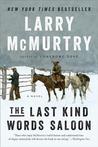
Anyone who knows me will almost certainly have heard me mention that Lonesome Dove by Larry McMurtry is one of my all time favourite books. I have read several other westerns penned by McMurtry, and whilst none of them has reached the heights of his Pulitzer-winning masterpiece, they have all been entertaining enough. So it was with some excitement that I spotted The Last Kind Words Saloon in a bookshop. I jumped at the chance to read a new McMurtry western, and the fact that it was short, was a plus for me, as I have very little time to read. That it was about Wyatt Earp, one of my favourite characters, clinched the deal.
I am not really sure what McMurtry was aiming for with The Last Kind Words Saloon, but it is written with his recognizable charm and sparse prose and has that feeling of authenticity that makes it feel as right as a well-worn pair of boots. Each chapter is a short vignette in the life of Earp, Doc Holliday, Charlie Goodnight and a handful of other western legends. The plot doesn't really go anywhere and McMurtry manages to sidestep and gloss over the showdown at the O.K. Corral, rather than make it the climax of the novel. I think this was intentional and perhaps says something about McMurtry's idea behind the novel. This is about the debunking of the western myths. Showing the sad, petty, violent and often lost people who became legends. There are no heroes in this vision of the American West, just drifters, drunks and chancers and some hard-working men and women who managed to forge a future for themselves in difficult times and in the harshest of terrains and climates.
It has the ennui of McMurtry's Buffalo Girls and perhaps even the shortness of the book was a nod to the subject matter being the sorrowful end of the golden age of the American frontier. If Lonesome Dove, with its close to a thousand pages, is a tour de force of western writing, The Last Kind Words Saloon, at about two hundred pages, feels like a shadow of McMurtry's most famous work, perhaps echoing the sad decline into insignificance of characters like Wyatt Earp who, rather than doing the decent thing and dying in a blaze of glory, lived out his later years in relative obscurity and poverty in California.
I enjoyed this book, mainly because McMurtry, even when he is not trying hard, can breathe life into his characters and write fabulous, insightful dialogue, but if you have not read Lonesome Dove, go there first. This one is for the true fan and best left as a slightly bitter digestif after the sumptuous main course.
Having conquered ancient Rome, Simon Turney turns his hand to medieval Spain.
Daughter of War is set in 1198. It is a period of upheaval and violence, a time of bloody reconquest, as Christians battle Moors to reclaim the kingdoms of Iberia. In this tumultuous time there are several factions, each vying for power, land and wealth and not all followers of Christ are friends of the Knights Templar. Against this canvas of intrigue, greed and uneasy alliances, Turney brings us the gripping tale of Arnau de Vallbona, a young knight, who finds himself thrust into conflict with a ruthless noble. Along with the lady he is sworn to protect, the honourable Arnau joins the "Poor Fellow-Soldiers of Christ and of the Temple of Solomon" where he learns there is great strength in giving oneself over to higher causes. And victory can come from placing one's faith not only in God, but in his new brothers and sisters of the Temple.
Turney is a master-storyteller and this is a classic, epic adventure that hurtles headlong like a galloping destrier. With prose and plotting as polished and sharp as a Templar's longsword, Simon Turney propels the reader into the turbulent time of twelfth century Spain.
It is always great to read a positive review of my books. But it is even better than normal, when the reviewer is a talented author of historical fiction whom I admire. This is the case with Jemahl Evans, whose Blandford Candy series of novels set in the English Civil War is brilliant.
Jemahl Evans' review of KILLER OF KINGS is below, but to sum up: "bloody brilliant! Matthew Harffy just gets better and better"