Saturday, 30 April 2016

Amazing news!

I've got some amazing news! After several months of work and planning behind the scenes, I am extremely pleased to be able to announce that the Bernicia Chronicles are to be published by Aria, the new imprint from the dynamic and award-winning independent publisher, Head of Zeus.


THE SERPENT SWORD will be re-published on 1st June 2016 (available now on pre-order). You can read a sample of it (and see the lovely new map) here.


THE CROSS AND THE CURSE will be re-published on 1st October 2016 (available now on pre-order).

BY BLOOD AND BLADE will be published in January 2017.

KIN OF CAIN (a novella) will be published in April 2017.

Book 4 of the Bernicia Chronicles (title TBD) will be published in June 2017.

All the books will be available as e-books, paperbacks and audio books (which I am particularly looking forward to). I am very excited to be working with such a wonderful team of talented professionals at Aria who are going to help lift the Bernicia Chronicles to greater heights and to get the books out to a wider audience.


If you've already read The Serpent Sword and The Cross and The Curse, thank you, and I'm sorry that you will have to wait a few more months than I'd originally expected for By Blood and Blade, but I'm sure the wait will be worth it and you'll be as happy as I am with the results.

Happy reading!

Matthew

Tuesday, 26 April 2016

REVIEW: Audiobook of The Lord of Ireland by E.M. Powell

The Lord of Ireland (The Fifth Knight, #3)The Lord of Ireland by E.M. Powell
My rating: 4 of 5 stars

This is the first book I have 'read' in the "Fifth Knight" series by E.M. Powell. I'd read lots of positive reviews of the first two novels, Fifth Knight, The and The Blood of The Fifth Knight, so I jumped at the chance of listening to the audiobook of The Lord of Ireland.


Story:

The blurb on the book is as follows:

"John is a prince without prospect of a crown. As the youngest son of Henry II, he has long borne the hated nickname "Lackland." When warring tribes and an ambitious Anglo-Norman lord threaten Henry's reign in Ireland, John believes his time has finally come. Henry is dispatching him there with a mighty force to impose order.
Yet it is a thwarted young man who arrives on the troubled isle. John has not been granted its kingship - he is merely the Lord of Ireland, destined never to escape his father's shadow. Unknown to John, Henry has also sent his right-hand man, Sir Benedict Palmer, to root out the traitors he fears are working to steal the land from him.
But Palmer is horrified when John disregards Henry's orders and embarks on a campaign of bloodshed that could destroy the kingdom. Now Palmer has to battle the increasingly powerful Lord of Ireland. Power, in John's hands, is a murderous force - and he is only just beginning to wield it."

Review:

Not having read the first two books, I wondered whether I would miss anything in the story, but I needn't have worried. The salient points from the previous novels were clear and the novel works well as a standalone adventure. I know the previous books are labelled as historical mysteries/thrillers, but this seemed to fit firmly in the historical action adventure camp, rather than mystery. This is not a bad thing in my opinion.

The characters are strong and well-portrayed and the story flows well and quickly. I knew nothing about Prince John's campaign in Ireland, so I not only enjoyed the ripping tale of intrigue, battles and skulduggery, but I also felt I learnt quite a bit in the process. The historical note at the end of the novel added to my enjoyment, with succinct and entertaining information about the period and how some of the details that Powell had use almost directly from the chroniclers' accounts from the time. It's amazing what nuggets an author can find that just cry out to be used.

The hero and heroine of the piece were not my favourite characters, in fact I found Palmer's wife to be annoying in her moralistic view of things, though she is a good foil for the evil Prince John. John Lackland is suitably ineffective and generally underhand and greedy, traits that have seen him play the villain over and over in fiction. I couldn't help wonder whether he was really as useless as portrayed, but then the notes on the history seemed to bear out the image of him. I guess he is so often the baddie in books and films because he really was nasty!

My favourite character was Hugh de Lacy, as he seemed the most nuanced. Is he good or bad? Vicious or kindly? He is as robust a character as you are likely to find and of all the cast, he felt like the most real and also the one I'd most like to share a cup of wine with. Though I doubt he'd have had much time for me!

The story has a good deal of action, with gripping fights and chases, as the protagonists seek to prevent John from totally wrecking his father's realm whilst they also try to avoid being killed by the impetuous and cruel prince.

My verdict?

A fast-paced adventure that tells the story of John Lackland's catastrophic Ireland campaign with a good dose of intrigue and action thrown in for good measure.

Narrator:

This was the weakest part of the package for me. James Langton is clearly a skilled narrator, giving each character a unique voice, and performing the dialogue well. However, there was something about his general intonation that I found just didn't click with me. He would sometimes stress words on the 'wrong' syllable or go up at the end of sentences as if asking a question. This didn't make the book difficult to listen to and is purely a matter of personal taste, but I couldn't help thinking a different narrator, perhaps one with a bit more gravitas, would have done the material more justice.

Overall score:

4 out of 5 stars

View all my reviews

Saturday, 9 April 2016

REVIEW: Audiobook of War at the Edge of the World by Ian Ross


War at the Edge of the World by Ian James Ross
My rating: 4 of 5 stars

I recently had a long trip ahead of me for work and decided to get an audiobook from Audible to listen to during the interminable flights, waits in airport lounges and taxi rides. I have had my eye on Ian Ross's debut, War at the Edge of the World, for some time, so I downloaded the book onto my phone and away I went.


Story:

The blurb on the book is as follows:

"The epic first installment in a new series set at the end of empire in the reign of the Emperor Constantine, The War at the Edge of the World follows newly promoted centurion Aurelius Castus into the tumultuous battle for the future of Rome.
Once a soldier in an elite legion from the Danube, now stuck in Britain's provincial backwater, Castus believes his glory days are over. But fate is about to intervene. When the king of the Picts, the savage people beyond Hadrian’s Wall, dies in mysterious circumstances, Castus is selected to command the bodyguard of a Roman envoy sent to negotiate with the barbarians.
But the diplomatic mission ends in bloody tragedy. Castus and his men are soon fighting for their lives and the legionary discovers that nothing about his doomed mission was ever what it seemed."

Review:

I haven't read a lot of Roman-era historical fiction, which I think might well have been a good thing here, as I am sure there are many comparisons that could be made to the work of other writers such as Riches, Scarrow and Kane.

As it is, free from the fetters of comparisons, I thoroughly enjoyed the journey into Ross's blood-spattered vision of 4th century Britain. The story is quite straightforward, but the gruff protagonist carries the story as easily as he dispatches his enemies with sword, spear or his bare hands.

The narrative rattles along, with a good dose of intrigue and more than enough action for this reader. The story was satisfying, with some great battle scenes. The only area I thought the book lacked a little was in the depth of the supporting cast. For the most part, they come and go, and I was not that upset if they died, or pleased if they survived the bloody uprising of the Picts.

Having said that, Aurelius Castus is a great, strong heroic figure who I am sure will go on to more exciting adventures in the future novels of the series.

My verdict?

An action-packed, blood-soaked vision of the untamed northern fringes of the Roman Empire of the 4th century.

Narrator:

Jonathan Keeble reads the story with verve and passion. Of the handful of audiobooks I have listened to in the last few years, Keeble was the best narrator by some distance. Each character has a recognisable voice with nuances and a specific delivery of dialogue that really lifts the narrative. The battle scenes are gripping and Keeble easily conveys the excitement and horror of facing enemies who are close enough to smell their breath and sweat.

Overall score:

4 out of 5 stars

View all my reviews

Thursday, 31 March 2016

What E.M. Powell learnt when writing The Lord of Ireland


This is the first in a new series of guest posts where an author will talk about something (or somethings) they've learnt while doing something. This is very open-ended and results in a title in the following form: "What A.N. Author learnt when Doing Something."

I hope it will be an interesting series, and I'm looking forward to learning more about some of the great authors who are writing historical fiction at the moment.

So, without further ado, let me welcome to my blog the wonderful, E.M. Powell.

What E.M. Powell learnt when writing The Lord of Ireland

As any novelist will tell you (even if you don’t ask them), writing a novel is hard work. It usually takes several months and if you add in the extra time for the extensive research that writing a historical novel takes, you can add in a few more. I don’t know what it’s like for other writers, but for me, there are always key things that I discover in the course of the creation of said novel that will always stay with me.

Now, some of those things are writerly and noble, like an exciting research finding or the development of a character of whom I grow particularly fond. Others are quite random. I cannot, for instance, ever think of the wolf chase scene in The Fifth Knight, the first in my medieval thriller series, without thinking of pointing. As in mortar. This is because the entire outside of the house was being repointed as I wrote those chapters. So, yes: snow + howl + pursuit + blood + death is always alongside drill noise + dust.

A Fox and a Wolf (Public Domain)

It was exactly the same when I was writing The Lord of Ireland, the third book in the Fifth Knight series and my latest release. That book now has its own mixed collection of noble and random that are hard-wired into my brain. So when Matthew so kindly asked me to post on ‘What I learnt…’, how could I resist? Here are a few that are suitable for public consumption.

The Lord of Ireland is set during John’s (yes, THAT John- youngest son of Henry II and future Bad King John) disastrous campaign in Ireland in 1185. John was sent there as Lord of Ireland, a title granted to him by Henry. I learnt that one of the reasons Henry sent John was the King feared that one of his own men, Hugh de Lacy, 1st Lord of Meath, was getting far too big for his boots. De Lacy features as one of the major characters in the novel and so I made a visit to Trim Castle, which was constructed over a thirty-year period by de Lacy and his son Walter. It’s the largest Anglo-Norman castle in Ireland and is truly impressive. No wonder Henry was jittery.


Trim castle Exterior and Interior © E.M. Powell

On a smaller scale, I viewed some fabulous 12th century artefacts in Waterford City. (Waterford was where John first landed and is the site of that infamous beard-pulling of the Irish by John. Oh, John.) Waterford has its very own Medieval Museum, which is just wonderful as well as the collections in the medieval Reginald’s Tower.

12th Century Boot © E.M. Powell

I learnt about the Viking board game of hnefatafl, too. The gaming pieces could be pegged into the board, which meant it could be played anywhere, including on board a moving ship. This board dates from c1150. My favourite piece is the knight on the right hand side. He was excavated beside the hearth of a Hiberno-Norse house and is slightly charred. I hope no-one mistook him for firewood- he's far too lovely.
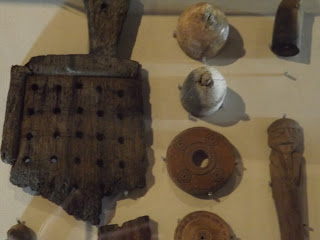
Gaming Pieces incl Hnefatafl Board © E.M. Powell

I also learnt that there is a Twitter account for the board game of hnefatafl @cyningstantafl. Do we follow each other? You betcha. That’s exactly the kind of thing Twitter’s for.

Speaking of John, I was especially pleased to see his c1370 representation in the Great Charter Roll in the Medieval Museum. The illustrator may have been drawing John one hundred and fifty years after his death but I was particularly taken with the facial expression.

John, Lord of Ireland © E.M. Powell

As The Lord of Ireland was in its final, final proof-reading stages, I had the previously unknown experience of one of my books being published in another language. The Fifth Knight had become Der fünfte Ritter and was released in Germany and promptly ended up on the Bild bestseller list. I learnt that whatever illusion of control/influence you might have over your novel’s release in English, in a language you don’t speak, you have none. I also learnt that Google Translate becomes your best friend.

Der fünfte Ritter © E.M. Powell

I could mention so many other things that I learnt. That’s the joy of writing historical fiction. It might be concerned with the past, but it brings a new richness to your life and knowledge every day.
And although I write 12th century, not everything is from eight hundred years ago. I learnt that the phrase ‘get medieval’ is now a documented and recognised phrase in the Oxford English Dictionary. Its entry follows the usual and correct OED format in terms of definition followed by first usage, and reads thus: ‘U.S. to get medieval: to use violence or extreme measures on, to become aggressive. 1994   Q. Tarantino & R. Avary Pulp Fiction 131,   I ain't through with you by a damn sight. I'm gonna git Medieval on your ass.’

Learning is a wonderful thing.

=-=-=-=-=-=-=-=-=-=-=-=-=-=-=-=-=-=-=-=-=-=

E.M. Powell’s medieval thrillers THE FIFTH KNIGHT and THE BLOOD OF THE FIFTH KNIGHT have been #1 Amazon bestsellers and a Bild bestseller in Germany. Book #3 in the series, THE LORD OF IRELAND, will be published by Thomas & Mercer on April 5 2016. Born and raised in the Republic of Ireland into the family of Michael Collins (the legendary revolutionary and founder of the Irish Free State), she now lives in northwest England with her husband, daughter and a Facebook-friendly dog. She is also a contributing editor to International Thriller Writers The Big Thrill magazine, blogs for English Historical Fiction Authors, reviews fiction & non-fiction for the Historical Novel Society and is part of the HNS Social Media Team.

Find out more by visiting www.empowell.com.

Connect with E.M. Powell:

Amazon Author Page: http://author.to/EMPowell-Author
Waterstones Author Page: https://www.waterstones.com/author/e-m-powell/2930720
Blog: http://www.empowell.blogspot.co.uk/
Facebook: www.facebook.com/empowellauthor
Twitter: https://twitter.com/empowellauthor

Tuesday, 15 March 2016

I'm speaking at the HNS Conference Oxford 2016!

I am delighted to announce that I have been invited to speak at the Historical Novel Society's annual conference in Oxford on 2nd - 4th September 2016.

And not just on one panel...but two!

On Saturday, 3rd September, at 2.30pm

Battle Scenes - Guts, gore and glory 

In which I will mostly be listening in awe to the following great authors: Justin Hill, Douglas Jackson, Simon Scarrow, Harry Sidebottom

I really cannot believe I am going to be on a panel with these luminaries of historical fiction!

On Sunday, 4th September, at 11.30pm

Working with an Agent v Going Solo - Comparing notes 

In which I will be chatting with fellow author, Hazel Gaynor, and agents, Lisa Eveleigh, and Joanna Swainson.

See the full programme here: https://hnsoxford2016.org/conference/programme/

There are still places available if you would like to book. It is not just for writers, but for all lovers of historical fiction.

If you are come along, let me know and I hope to see you there!


Sunday, 6 March 2016

REVIEW: Tobias by Prue Batten

Tobias (The Triptych Chronicle Book 1)Tobias by Prue Batten
My rating: 4 of 5 stars

This is the first book of Prue Batten's I've read and it did not disappoint.

It is the tale of the eponymous hero of the novel, Tobias, a dwarf minstrel. To have a protagonist who has to contend with the struggles related to being born different, make for an interesting read and Batten brings to life the complexities of living with achondroplasia in medieval Europe. Tobias, his twin brother, Tomasso, and most of the cast of characters come from Prue Batten's Gisborne series of books, but they are all well-defined here and I felt I got enough of their backstory for the most part to understand their motivations and desires.

Batten's prose is rich and lush, like ribbons of embroidered silks trailing through the mind. The settings are vivid and real. It was easy to imagine the author had spent years of her life in the locales of Constantinople, Crete and Venice, but as she lives in Tasmania, I don't think this is the case. All I can assume is that she carried out exhaustive research and then fleshed it out with a delightfully detailed imagination. An imagination that sees every pebble on a beach, each bag of spices spilled onto the cobbles of the Byzantine harbour-side, every stitch on a sweat-stained gambeson. Batten is able to conjure each zephyr blowing over the Adriatic, the scent of sweet fruit syrup cordials drunk in the coolness of a merchant's walled garden, the icy bite of a steel misericorde blade slicing into pliant flesh. Her writing is sumptuous, and the plot, whilst quite straightforward, is well-drawn and leads the reader to the inexorable violent conclusion.

Although the time and the place of the story is very different, there was something about the interaction of certain characters, the absolute authenticity of the locations and the poetry of the prose that at times reminded me of the great Patrick O'Brian. For historical fiction, there is really no greater praise.

The only character I found hard to connect with was Tomasso. I found him unlikable and thoroughly unpleasant. It is clear that he is meant to be perceived that way and a large part of the plot revolves around his selfish and self-destructive behaviour, but by the end of the story, I didn't care whether he found redemption from his sins, or was utterly destroyed by his thoughtless actions. I wondered whether I would have felt differently if I'd read the previous trilogy, and whether the denouement of the plot would have been more heart-wrenching as a result.

This is a big story told through the eyes of a little person. Prue Batten brings us a rich tale of deceit, intrigue, politics and violence. And she does so with poetic writing and real verve.

View all my reviews

Saturday, 20 February 2016

EHFA guest post: The ruins of Rome beneath our feet

Today, with a little help from my daughter, Iona, I have a guest post on the English Historical Fiction Authors blog about the richness of Roman remains that lie just beneath our feet all over Britain:

http://englishhistoryauthors.blogspot.co.uk/2016/02/the-ruins-of-rome-beneath-our-feet.html